
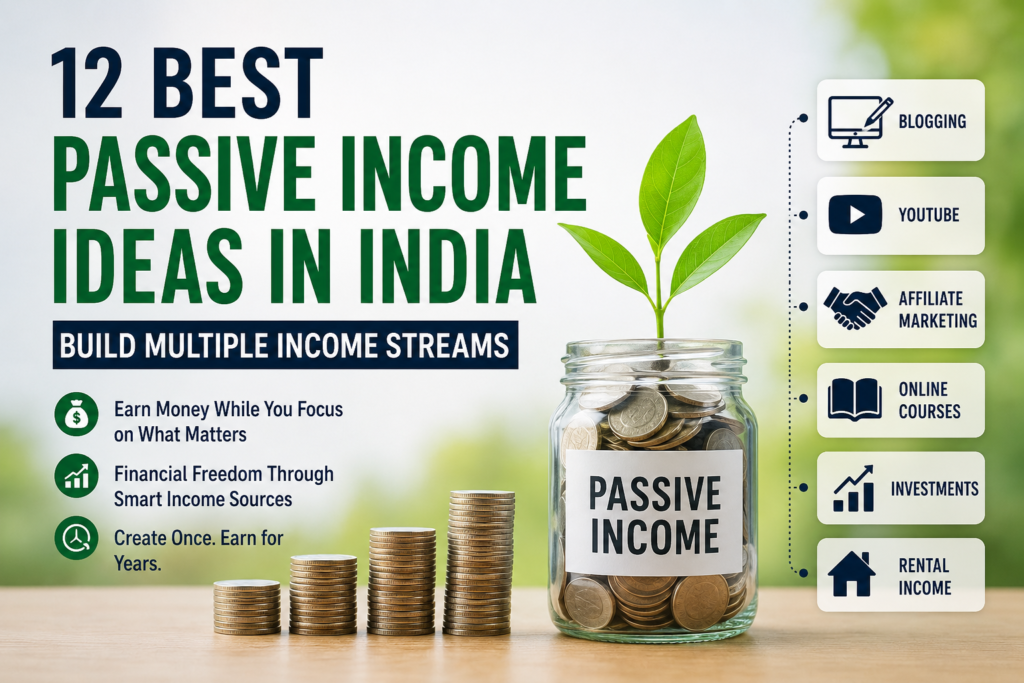
12 Best Passive Income Ideas in India: Build Multiple Income Streams
Many people dream of earning money without having to work for every rupee every day. This is one reason passive income has become such a popular topic.
The idea sounds simple: put in some effort or money today and continue receiving income later.
But real passive income is not the same as “easy money.”
Most passive income ideas require something upfront. You may need to invest money, create useful content, build an audience, develop a product, learn a skill, or set up a system. Even after the income starts, some level of monitoring and maintenance is usually necessary.
The good news is that there are many ways to build additional income streams in India. Some require more money but less daily effort. Others require very little money but demand more time and skill in the beginning.
Blogging, YouTube, affiliate marketing, digital products, online courses, investments, REITs, rental assets and other models can all play different roles. The right option depends on your skills, available time, financial situation and willingness to take risk.
The goal should not be to find a magical method that makes you rich overnight.
A better goal is to build an income-producing asset or system that can continue generating value after the initial work has been done.
In this guide, we will explore 12 practical passive income ideas in India, how each one works, what it may require, its advantages and limitations, and who may find it suitable.
What Is Passive Income?
Passive income is income that can continue to come in without requiring the same level of active work for every payment.
For example, if you create an ebook and sell the same digital product repeatedly, you may not need to recreate the ebook for every customer.
Similarly, an investment may generate interest, dividends or other returns without requiring you to work on the underlying asset every day.
However, almost no income stream is completely passive.
A blog needs maintenance.
A YouTube channel needs content and audience engagement.
A rental property needs management.
Investments need monitoring and decision-making.
Digital products may need updates.
That is why it is more useful to think of passive income as income that can become less dependent on your daily working hours.
This distinction is important because many online advertisements make passive income sound effortless. In reality, successful passive income usually comes from work done earlier, money invested earlier, or systems that reduce the amount of ongoing effort required.
Active Income vs Passive Income
The easiest way to understand passive income is to compare it with active income.
If you work for a salary, you generally receive income because you provide your time and skills to an employer.
If you work as a freelancer, you usually get paid for completing specific projects or services.
These are forms of active income because your continued work is closely connected to your earnings.
Passive or semi-passive income works differently.
You may create an asset, make an investment or build a system that can continue producing income after the initial work.
For example, a blogger may spend several hours researching and writing an article. If that article later attracts search traffic and earns advertising or affiliate income, the original work may continue creating value.
The same principle can apply to a digital template, online course, YouTube video, investment or rental asset.
The key difference is not that passive income requires no work.
The key difference is that the income can become less directly tied to every hour you work.
Why Build Multiple Income Streams?
Depending entirely on one source of income can make your financial situation more vulnerable.
If your salary stops, your main source of income may disappear.
If a business loses customers, revenue may decline.
If an online platform changes its rules, a creator’s income may be affected.
Having multiple income streams does not eliminate financial risk, but it can help diversify where your income comes from.
For example, someone might have a regular job, a small blog, an investment portfolio and a digital product.
These sources may not produce equal amounts of money.
One may be active, another semi-passive and another investment-based.
The goal is not necessarily to build ten different businesses.
The goal is to gradually create additional sources that make sense for your situation.
Building multiple income streams also starts with managing the money you already have. For practical tips, read our guide on Money Management Tips: How to Control Expenses and Build Wealth Slowly.
1. Start a Blog or Niche Website
Blogging is one of the most accessible passive income ideas for people who enjoy writing, research or teaching.
You create useful articles around a specific topic, attract visitors through search engines or social media, and then monetise the traffic.
A blog can earn through advertising, affiliate marketing, sponsorships, digital products and other methods.
The biggest advantage of blogging is that a useful article can continue attracting visitors long after it is published.
For example, an article explaining how to manage money, choose a product or solve a common problem may continue receiving search traffic months or even years later.
But blogging is not quick income.
A new website usually needs time to build content, authority and traffic.
You also need to learn basic SEO, understand your audience and keep your information accurate.
How Blogging Can Become Semi-Passive
The initial work is usually high.
You need to:
Research topics.
Write articles.
Create images.
Optimise pages.
Build internal links.
Promote content.
Improve technical SEO.
But once a website has a strong library of useful content and receives consistent organic traffic, some older articles may continue generating visitors without daily work.
That is what makes blogging attractive as a long-term income model.
How a Blog Can Make Money
A successful blog may use several revenue sources.
Advertising can generate income from website traffic.
Affiliate marketing can generate commissions when readers purchase products through qualifying links.
Sponsored content can provide another revenue source.
You can also sell your own ebooks, templates, courses or other digital products.
However, traffic alone does not guarantee income.
The audience needs to be relevant, and the monetisation method needs to match the content.
Who Should Consider Blogging?
Blogging can be suitable for people who:
Enjoy writing or research.
Have patience for long-term growth.
Are willing to learn SEO.
Can consistently publish useful content.
Want to build a digital asset over time.
The main disadvantage is that it can take months before meaningful results appear.
2. Start a YouTube Channel
YouTube can become another long-term income-producing asset.
Instead of writing articles, you create videos that solve problems, answer questions, explain topics or entertain viewers.
A useful video can continue receiving views after it is published.
This is particularly true for evergreen content such as tutorials, educational videos, product explanations, how-to guides and informational content.
YouTube income can come from advertising and, depending on the channel and audience, sponsorships, affiliate marketing, memberships, products or services.
But building a channel requires consistent effort.
You need to create videos, improve titles and thumbnails, understand audience behaviour and keep producing useful content.
A channel should not be started with the assumption that every video will go viral.
A better approach is to create a library of useful videos that can attract viewers over time.
How to Make YouTube More Sustainable
Choose a topic you can continue discussing.
Create videos that answer real questions.
Improve your thumbnails and titles.
Study which videos attract useful traffic.
Reuse ideas across different formats without simply copying content.
Focus on building trust with your audience.
A strong audience can eventually become an important digital asset.
3. Affiliate Marketing
Affiliate marketing allows you to earn a commission by recommending products or services through special tracking links.
For example, a blogger may review a product and provide an affiliate link. If a reader makes a qualifying purchase through that link, the creator may receive a commission according to the affiliate programme’s terms.
This model can work particularly well with content such as:
Product reviews.
Comparisons.
Buying guides.
Tutorials.
Best-of lists.
Problem-solving articles.
The important thing is to recommend products that are genuinely relevant to your audience.
Why Affiliate Marketing Can Become Semi-Passive
A useful article or video can continue attracting visitors.
If the content ranks well and remains relevant, it may continue generating qualifying clicks and sales without requiring you to create a new piece of content every day.
However, affiliate income is not guaranteed.
Search rankings can change.
Products can become unavailable.
Commission rates can change.
Affiliate programmes can change their terms.
That means you should treat affiliate marketing as one part of a broader income strategy rather than depending entirely on one programme.
The Biggest Mistake to Avoid
Do not recommend a product simply because it offers a commission.
Trust is more valuable than a short-term commission.
If your audience believes that you recommend products honestly, they are more likely to return to your content.
4. Create and Sell Digital Products
Digital products are attractive because you can create them once and potentially sell them many times.
Examples include:
Ebooks.
Printable planners.
Budget templates.
Study notes.
Design templates.
Canva templates.
Checklists.
Photography presets.
Spreadsheet tools.
Business templates.
Digital guides.
Unlike physical products, digital products do not normally require traditional inventory or shipping.
That can make the business model simpler.
However, the product still needs to solve a real problem.
A poorly designed ebook will not become successful simply because it is digital.
How to Choose a Digital Product
Start with a problem.
Ask yourself:
What does my audience struggle with?
What information would save them time?
What task could be made easier with a template?
What knowledge could be organised into a simple guide?
For example, if your audience is interested in personal finance, you might create a simple budgeting template.
If your audience is interested in blogging, you might create an SEO checklist.
The product should be useful enough that someone would willingly pay for it.
5. Create an Online Course
If you have strong knowledge of a subject, an online course can turn that knowledge into a digital asset.
You could teach:
English.
Computer skills.
Digital marketing.
Photography.
Cooking.
Fitness basics.
Craft skills.
Software.
Business skills.
Academic subjects.
The possibilities are wide.
A course requires significant effort in the beginning.
You need to plan lessons, create videos or written material, prepare examples and organise the learning experience.
You may also need to update the course later.
But once the course is created and hosted on an appropriate platform, students can access it without you teaching the same lesson individually every time.
Courses Work Best When They Solve a Clear Problem
A course called “Learn Everything About Business” may be too broad.
A course such as “How to Create Your First WordPress Website” has a clearer outcome.
People are more likely to understand what they are paying for when the course has a specific purpose.
You also need to be honest about the expected results.
Do not promise students guaranteed income or unrealistic outcomes.
6. Sell Stock Photos, Videos or Design Assets
If you are interested in photography, video, illustration or graphic design, you can create digital assets and license them through suitable marketplaces.
Examples include:
Stock photographs.
Video clips.
Illustrations.
Icons.
Presentation templates.
Fonts.
Design elements.
Music or sound effects, where licensing allows.
The basic idea is simple.
You create a useful asset once, upload it to a marketplace and potentially earn when customers license or purchase it.
This can become a long-term digital income stream if you build a large library of useful assets.
However, competition can be high.
You need quality, originality and an understanding of what customers actually need.
7. Invest Through Mutual Funds or Other Long-Term Investments
Investment-based income is another category of passive or low-effort income.
Instead of creating content or running a business, you put capital into financial assets that may generate returns over time.
Mutual funds are one example.
A systematic investment plan, or SIP, allows an investor to invest a fixed amount regularly in a mutual fund scheme.
However, mutual fund returns are not guaranteed.
Market-linked investments can rise and fall, and investors can lose money.
The purpose of long-term investing should not be to find a guaranteed monthly income.
It should be based on your financial goals, time horizon and risk tolerance.
Why Long-Term Investing Can Be Useful
Investing can allow your existing money to participate in economic growth.
Instead of relying only on your labour to create income, you are also putting capital to work.
But investment decisions should be made carefully.
Before investing, understand:
What the investment owns.
How returns are generated.
What risks are involved.
What fees apply.
How easily you can access your money.
What time horizon makes sense.
Never invest simply because someone online claims that an asset will definitely rise.
8. Dividend-Paying Investments
Some companies distribute part of their profits to shareholders through dividends.
This makes dividend-paying stocks attractive to some investors who want income from their investments.
However, dividends are not guaranteed.
A company can reduce, suspend or change its dividend depending on its financial condition and decisions.
The share price can also fall.
Therefore, buying a stock only because it currently pays a high dividend can be risky.
A better approach is to understand the underlying company, its financial health, business model, valuation and dividend history.
Dividend income should be considered as one component of an investment strategy, not as guaranteed salary.
9. Consider REITs for Real Estate Exposure
Real estate can generate rental income, but buying a property directly usually requires significant capital and ongoing management.
Real Estate Investment Trusts, commonly called REITs, provide another way to gain exposure to income-producing real estate.
REITs generally own or operate income-generating properties, and investors can buy units of a listed REIT rather than purchasing an entire commercial property themselves.
This can provide a more accessible way to participate in the real-estate market.
However, REITs are still investments.
Their prices can move up and down, distributions can vary and the underlying real estate market can face risks.
You should understand the specific REIT, its assets, debt, occupancy and other relevant factors before investing.
10. Rent Out an Asset You Already Own
Sometimes passive income does not require buying something new.
You may already own an asset that is not being fully used.
Depending on your circumstances, this could include:
A spare room.
A parking space.
Equipment.
A camera.
A vehicle.
A storage area.
Specialised tools.
The basic idea is to generate additional income from an existing asset.
However, renting out an asset is not completely passive.
You may need to deal with maintenance, customers, agreements, safety, taxes and other responsibilities.
Before renting anything, understand the legal and practical requirements that apply to your situation.
Start With What You Already Have
This approach can reduce the amount of new capital required.
Instead of asking:
“What should I buy to create passive income?”
ask:
“Do I already own something that could create useful income?”
That simple question can sometimes reveal opportunities.
11. Create a Print-on-Demand Business
Print-on-demand allows creators to sell designs on products such as T-shirts, mugs, notebooks, posters and other merchandise without necessarily keeping physical inventory themselves.
When a customer places an order, a print-on-demand provider can produce and fulfil the item according to the service’s model.
This can reduce the need to purchase large amounts of inventory upfront.
However, print-on-demand is not automatically passive.
You still need to create designs, choose products, build listings, market your store and handle customer issues.
Competition can also be high.
The strongest opportunity usually comes from creating designs for a specific audience rather than uploading generic images and hoping for sales.
For example, a niche community may respond better to relevant designs than a store trying to sell everything to everyone.
12. Build a Small Digital Tool or Online Service
If you have technical skills—or can work with someone who does—building a small digital tool can become a scalable income stream.
It could be:
A calculator.
A productivity tool.
A budgeting tool.
A simple business utility.
A niche website.
A subscription-based software product.
An AI-assisted tool.
The important thing is not the technology itself.
The important question is:
Does the tool solve a problem people are willing to pay to solve?
A simple tool that solves one specific problem can sometimes be more useful than a complicated product with too many features.
This model usually requires more technical work upfront than affiliate marketing or blogging, but it can potentially scale without requiring one-to-one service for every customer.
Which Passive Income Idea Is Best for Beginners?
There is no single best passive income idea for everyone.
Your best option depends on what you already have.
If you have time but very little money, content creation, blogging, affiliate marketing or digital products may be worth exploring.
If you have useful knowledge, an online course or digital guide may be suitable.
If you already have investment capital, you may consider appropriate financial assets.
If you own unused property or equipment, renting it may make sense.
The key is to match the method with your resources.
If You Have Very Little Money
Focus on ideas where your main investment is time.
Blogging.
YouTube.
Affiliate marketing.
Digital products.
Educational content.
These may require more time before they generate meaningful income.
If You Have Useful Skills
Consider turning your knowledge into an asset.
A course.
An ebook.
Templates.
Design resources.
A digital tool.
The advantage is that you are building something from knowledge you already have.
If You Have Investment Capital
You may explore investment-based income and long-term wealth-building options.
But higher capital does not remove risk.
Before investing, understand the asset and its risks.
How Much Money Can Passive Income Generate?
This is one of the most common questions, but there is no honest universal answer.
One person may earn nothing from a blog for many months.
Another may eventually earn a meaningful amount.
One investor may receive dividends, while another experiences a decline in the value of their portfolio.
A digital product might sell regularly, or it might barely sell if there is no demand.
Income depends on:
Audience size.
Product quality.
Market demand.
Competition.
Capital.
Skills.
Time.
Marketing.
Economic conditions.
Platform rules.
Consistency.
This is why you should be careful with articles or videos promising a fixed monthly income from passive income ideas.
There is no guaranteed ₹50,000, ₹1 lakh or ₹5 lakh monthly income from any of these methods.
A realistic strategy is to focus on building something useful and improving it over time.
How Long Does Passive Income Take to Build?
The timeline varies widely.
Investment income may begin relatively quickly after investing, but meaningful income generally depends on the amount invested and the return generated.
A blog may take months or longer to build meaningful traffic.
A YouTube channel may require many videos before the audience becomes substantial.
A digital product may take time to develop and market.
A rental asset may generate income after it is acquired and rented, but it requires capital and management.
The important point is that passive income is usually a long-term process.
If someone promises that you can start today and receive guaranteed large income next month, be cautious.
Can Passive Income Become a Full-Time Income?
Yes, it can happen for some people, but it should not be treated as a guarantee.
A person might gradually build several income sources until they produce enough money to cover their expenses.
For example, someone could combine:
Blog income.
Affiliate commissions.
Digital product sales.
Investment income.
YouTube revenue.
The important part is that each income source should be evaluated separately.
You should understand how much revenue it produces, what expenses are involved and how much ongoing work it requires.
A stream that produces ₹20,000 but requires 40 hours of work every month is very different from an investment that produces a similar amount with much less ongoing effort.
Why Multiple Small Income Streams Can Be Powerful
You do not need one huge passive income source.
Several smaller sources can sometimes create a stronger overall system.
For example:
₹5,000 from digital products.
₹7,000 from affiliate income.
₹8,000 from a content platform.
₹10,000 from investments.
The actual amounts will vary, but the principle is important.
You are not depending entirely on one source.
However, do not start ten projects at once.
Trying to build too many income streams can spread your time and attention too thin.
It is often better to build one reliable stream first and then add another.
The Difference Between Passive Income and Side Hustle
These terms are often confused.
A side hustle usually involves active work outside your main job.
Freelancing is a side hustle.
Online tutoring is a side hustle.
Social media management is a side hustle.
These can be excellent ways to increase income, but they are not necessarily passive.
Passive income usually becomes less dependent on continuous work.
For example, creating a digital product may require a lot of work initially, but once it is established, sales can happen without creating the product again for every customer.
This distinction matters because it helps you choose the right model for your goal.
If your immediate goal is to increase monthly income, active side work may actually produce results faster.
If your long-term goal is to build assets that can continue producing income, passive or semi-passive models may be more suitable.
How to Choose the Right Idea
Before choosing an income stream, ask yourself five questions.
1. How much money can I invest?
If your budget is small, avoid choosing a model that requires large capital.
2. How much time can I give?
Some models require months of work before they become semi-passive.
3. What skills do I already have?
Your existing skills can reduce your learning curve.
4. What level of risk can I accept?
Investment-based income carries financial risk, while content-based models may carry more time risk.
5. What do I actually enjoy?
If you hate writing, blogging may become difficult.
If you dislike appearing on camera, YouTube may not be comfortable.
The best idea is often the one you can realistically continue working on.
If you’re looking for practical ways to work toward a ₹500-per-day online income goal, read my beginner-friendly guide on How to Earn ₹500 Per Day Online in India for simple ideas and realistic steps you can explore.
A Simple Strategy for Beginners
If you are starting from zero, do not try to build multiple passive income streams immediately.
Start with one.
For example, you could begin with a blog.
Learn how to create useful content.
Build traffic.
Learn SEO.
Add affiliate links where appropriate.
Later, create a digital product.
Once that system becomes more stable, you could explore another income source.
This gradual approach can be easier to manage than starting five businesses at the same time.
Build Assets, Not Just Income
One of the most useful ways to think about passive income is to focus on assets.
An asset is something that can continue providing value.
A useful website can be an asset.
A library of YouTube videos can be an asset.
An ebook can be an asset.
A digital template can be an asset.
An investment portfolio can be an asset.
A rental property can be an asset.
The advantage of an asset is that your earlier work can continue producing value.
That does not mean the asset will always generate income.
Markets change.
Audiences change.
Technology changes.
Products become outdated.
But building assets gives you a way to separate some income potential from your daily working hours.
Common Passive Income Mistakes
Many people fail because they approach passive income with unrealistic expectations.
Expecting Instant Results
Most genuine income streams need time.
Believing Guaranteed Income Claims
No legitimate strategy can guarantee that you will earn a specific amount every month.
Choosing Too Many Ideas
Starting several projects at once can lead to unfinished work.
Ignoring Expenses
Revenue is not the same as profit.
Copying Other People
A business that works for one person may not work for another.
Ignoring Taxes and Regulations
Income can have tax implications, and different businesses or investments can have different rules.
Taking Too Much Financial Risk
Never invest money you cannot afford to lose simply because someone promises high returns.
Giving Up Too Early
Some models need time to develop.
Passive Income and Taxes in India
Passive income is still income, and the tax treatment can depend on the type of income you receive.
Interest, dividends, rental income, business income, capital gains and other forms of income may be treated differently under Indian tax rules.
The Income Tax Department provides information about different income categories and tax provisions, but your actual tax position depends on your circumstances.
Do not assume that income is automatically tax-free simply because it is called “passive income.”
If your income becomes significant or your situation is complicated, consider speaking with a qualified tax professional.
Protect Yourself From Passive Income Scams
The popularity of passive income has also created opportunities for scammers.
Be especially careful with offers that promise:
Guaranteed monthly returns.
Large income with almost no work.
Secret investment systems.
Risk-free trading.
Instant passive income.
High returns without explaining the risks.
A legitimate business can have good potential, but it still involves uncertainty.
Before paying for a course, platform, investment opportunity or business programme, research the provider carefully.
Do not make a financial decision simply because someone shows a screenshot of their income.
A screenshot does not prove that the business is profitable, sustainable or suitable for you.
Passive Income Does Not Mean No Work
This may be the most important lesson in this entire article.
Passive income is not about doing nothing.
It is about doing meaningful work upfront, creating an asset or investing capital, and then reducing the amount of ongoing effort required to maintain the income.
A blogger writes articles before earning from traffic.
A YouTuber creates videos before building an audience.
A course creator records lessons before selling the course.
An investor puts capital at risk before receiving returns.
A landlord buys or owns an asset before collecting rent.
Understanding this reality can protect you from unrealistic expectations.
What Is the Best Passive Income Idea in India for You?
The best idea is not necessarily the one that appears most often on social media.
It is the one that matches your situation.
If you have a laptop, internet access and time but limited capital, digital income models may be worth exploring.
If you have strong knowledge in a particular subject, you could create educational content or digital products.
If you have investment capital, you may consider appropriate long-term investment options.
If you have unused assets, rental income may be possible.
You do not have to choose the most complicated method.
Sometimes the simplest model is the easiest to maintain.
A Practical 12-Month Approach
If you want to build passive income gradually, think in terms of a year rather than a few weeks.
Months 1–3: Learn and Build
Choose one model.
Learn the basics.
Research your audience.
Create your first asset.
Do not worry about making a large income immediately.
Months 4–6: Improve
Study what is working.
Improve your content, product or investment strategy.
Remove things that are wasting time or money.
Months 7–9: Expand
If your first income stream is showing potential, consider adding a related source.
For example, a blog could add a digital product.
A YouTube channel could add affiliate marketing.
A digital product business could add another related product.
Months 10–12: Review
Look at the numbers.
How much time did you spend?
How much money did you invest?
How much revenue came in?
What were your expenses?
What worked?
What did not work?
Use this information to decide what to continue.
Final Thoughts
Passive income can be a useful part of a long-term financial strategy, but it should not be treated as a shortcut to getting rich.
The strongest passive income ideas usually have something valuable behind them.
A useful website.
A trusted audience.
A good digital product.
A valuable skill.
A well-researched investment.
A productive asset.
The income comes from the value that asset creates.
For beginners in India, there are many options to explore. Blogging, YouTube, affiliate marketing and digital products can be attractive when you have more time than capital. Investments, REITs and rental assets may be more suitable when you have capital and want to put assets to work.
You do not need to start everything at once.
Start with one realistic idea.
Learn how it works.
Build something useful.
Track your results.
Avoid unrealistic promises.
Then improve gradually.
Over time, you may be able to build multiple income streams that reduce your dependence on a single source of income.
The real goal is not to “earn while you sleep” every night.
The real goal is to build assets, skills and systems that can continue creating value even when you are not actively working every hour.
That is a much more realistic and sustainable way to think about passive income.
Frequently Asked Questions
Is passive income really possible in India?
Yes, passive or semi-passive income is possible, but it usually requires upfront time, money, skills or effort. It is not the same as earning money without doing anything.
What is the easiest passive income idea for beginners?
There is no single easiest option for everyone. Blogging, affiliate marketing, YouTube and digital products can be started with relatively limited capital, but they usually require significant effort before income becomes consistent.
Can I earn ₹1 lakh per month from passive income?
It is possible for some people to build income at that level, but it is not guaranteed. The amount depends on the business model, audience, investment, skills, market demand, expenses and many other factors. You should never treat ₹1 lakh per month as an expected or guaranteed result.
Which passive income idea requires the least money?
Content-based options such as blogging, YouTube and affiliate marketing can potentially be started with relatively low financial investment, although they require substantial time and effort. Free or low-cost entry does not mean easy or guaranteed income.
Is blogging passive income?
Blogging can become semi-passive when older articles continue attracting traffic and generating advertising, affiliate or product income. However, successful blogs require ongoing content updates, SEO work, technical maintenance and audience development.
Is YouTube passive income?
YouTube can become a semi-passive income source when older videos continue receiving views and generating revenue. However, building a successful channel usually requires consistent content creation, audience engagement and regular improvement.
Is affiliate marketing passive income?
Affiliate marketing can become semi-passive when evergreen content continues generating qualifying clicks and sales. However, commissions are not guaranteed, and links, products, search rankings and affiliate programme terms can change.
Is dropshipping passive income?
Dropshipping is generally better described as an online business rather than pure passive income. It can involve product research, marketing, customer service, supplier management, refunds and order problems. Some systems can be automated, but ongoing work is still required.
Are mutual funds passive income?
Investing in mutual funds can be a relatively low-effort way to participate in financial markets, but returns are not guaranteed. Mutual funds can rise or fall in value, and
Are dividends guaranteed?
No. Companies can change, reduce or stop dividend payments. Dividend-paying investments can also lose market value.
Can I start passive income without money?
Some models can be started with very little money, but they usually require your time and effort instead. Blogging, content creation, affiliate marketing and creating digital products can be examples.
How many passive income streams should I have?
There is no ideal number. Starting with one manageable income stream and gradually adding another may be more practical than trying to build many projects at the same time.
How long does it take to build passive income?
There is no fixed timeline. Some investment income can begin after investing, while digital income models may take months or longer to build. Your results will depend on the method, market, effort, capital and consistency.
Important Disclaimer
This article is for general educational and informational purposes only. It is not financial, investment, tax, legal or business advice. Passive income is not guaranteed, and every income method involves different levels of effort, risk, cost and uncertainty. Investment values can fall, businesses can lose money, and online income can change because of competition, platform policies and market conditions. Before investing money or starting a business, research the opportunity carefully and consider your own financial situation. Where appropriate, consult a qualified financial, tax or legal professional.
Conclusion
There is no magic formula for passive income.
There are, however, many legitimate ways to build income-producing assets over time.
The most important step is to stop looking for the fastest method and start looking for the method you can realistically build.
Choose something that matches your skills.
Start within your means.
Create genuine value.
Be patient.
Track your results.
And never confuse a marketing promise with a guarantee.
With the right approach, passive income can become one part of a broader financial plan—helping you create more flexibility, diversify your income and work toward greater financial independence over time.