
Affiliate marketing for beginners
Affiliate marketing has become one of the most popular ways to explore online income, especially for beginners who want to build something without creating their own physical products. The basic idea sounds simple: you recommend a product or service through a special affiliate link, and if someone makes a qualifying purchase through that link, you may receive a commission.
But successful affiliate marketing is not simply about posting links everywhere and waiting for money to arrive.
The real work is understanding an audience, choosing useful products, creating helpful content, attracting the right visitors, and earning their trust. A beginner may spend considerable time learning and creating content before receiving the first commission.
That is why it is better to think of affiliate marketing as a content-based online business model, rather than a quick-money scheme.
The good news is that you do not need to manufacture products, maintain physical inventory, or handle shipping yourself. You can focus on helping people discover products and services that genuinely match their needs.
In this guide, we will explain affiliate marketing for beginners from the ground up. You will learn how affiliate marketing works, how to choose a suitable niche, how to find legitimate affiliate programmes, how to create useful content, how to attract visitors, what mistakes beginners should avoid, and how to build a more sustainable affiliate income strategy.
Most importantly, we will keep the expectations realistic. There is no guaranteed income, no magic shortcut, and no fixed timeline for earning your first commission. Your results can depend on your niche, audience, content quality, traffic, product demand, commission structure and consistency.
If you are willing to learn, experiment and improve over time, affiliate marketing can become a useful skill and potentially a long-term online income stream.

What Is Affiliate Marketing?
Affiliate marketing is a performance-based marketing model in which a business rewards a third party for generating a qualifying sale, lead, or other agreed action.
The third party is commonly called an affiliate or publisher. The business provides a special tracking link or another method of identifying referrals. When someone clicks the affiliate’s link and completes the required action, the affiliate may receive a commission according to the programme’s terms.
For example, imagine you run a blog about useful tools for students. You write an honest article explaining how a particular productivity tool works. If the company has an affiliate programme, you may include your unique affiliate link in the article. A reader who is interested can visit the company’s website through your link. If that reader makes an eligible purchase, you may earn a commission.
The important part is that the affiliate is not normally responsible for manufacturing, storing, packaging, or delivering the product.
Your role is mainly to connect the right audience with useful products or services through helpful content.
This makes affiliate marketing attractive to content creators, bloggers, YouTubers, social media creators, educators, and website owners. However, having an affiliate link alone does not create income. People need a reason to click it, and they need enough confidence in your recommendation to take action.
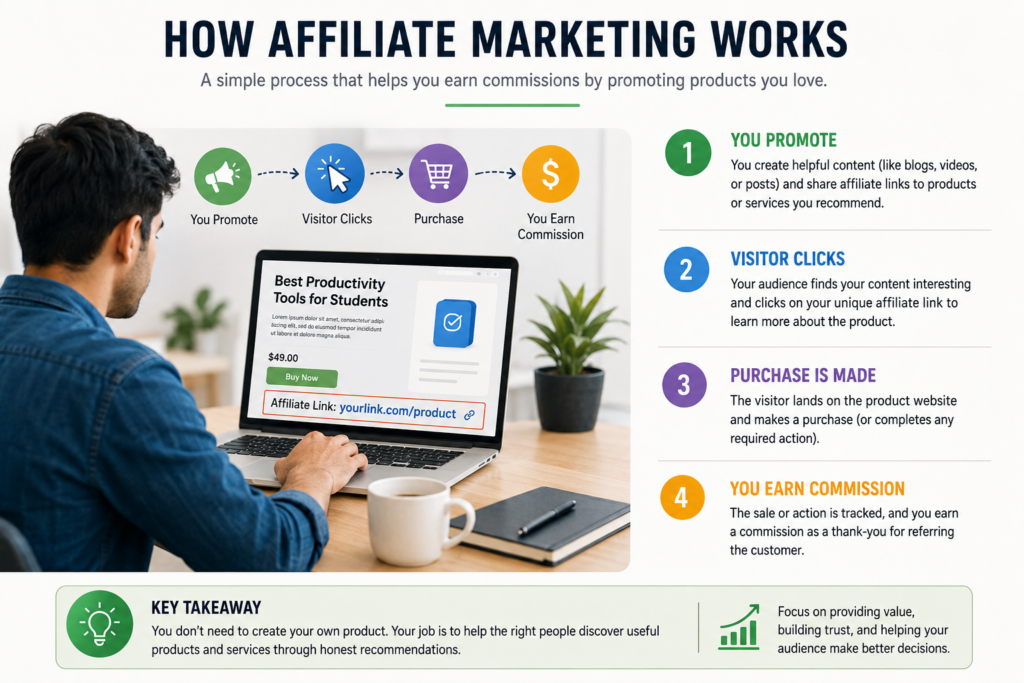
How Does Affiliate Marketing Work?
The process can be understood through a simple chain.
A company creates a product or service and offers an affiliate programme. The affiliate joins that programme and receives a unique tracking link. The affiliate then creates content that is relevant to the product and shares the link where it naturally helps the audience.
A visitor discovers the content, learns about the product, and decides whether it is suitable for them. If the visitor clicks the affiliate link and completes the qualifying action required by the programme, the transaction is tracked and the affiliate may receive a commission.
The exact process can vary between programmes. Some pay for completed purchases, while others may pay for qualified leads, registrations, app installations, or other actions.
This is why beginners should always read the programme’s current terms before promoting anything.
The Four Main Parts of Affiliate Marketing
A successful affiliate marketing system generally involves four important parts: the merchant, affiliate, customer, and affiliate network or tracking system.
The merchant is the company or business selling the product or service.
The affiliate is the person or organisation promoting that product.
The customer is the person who takes the qualifying action.
The tracking system connects the referral to the affiliate so that the appropriate commission can be recorded.
Not every affiliate programme uses a separate affiliate network. Some companies operate their own programmes directly.
Understanding these roles helps beginners see why affiliate marketing is more than simply placing links inside articles. It is a system connecting businesses, publishers and customers.
Why Affiliate Marketing Is Attractive to Beginners
Affiliate marketing can be attractive because you can start by promoting products created by other businesses instead of developing your own product from scratch.
A traditional online store may require inventory, packaging, shipping, customer support, and other operational responsibilities. With affiliate marketing, much of that work is handled by the merchant. Your main responsibility is to create useful content and bring the right audience to the product or service.
Another advantage is flexibility. You can build affiliate content through a blog, YouTube channel, social media platform, email newsletter, or another legitimate content channel. This gives creators different ways to reach an audience.
However, flexibility does not mean that affiliate marketing is effortless.
You still need to learn how your chosen platform works, understand your audience, research products, create quality content, follow disclosure requirements, and monitor your results. Building traffic can take time, especially when competing with established websites and creators.
Can You Start Affiliate Marketing With No Money?
In some cases, you can begin learning and creating content without spending much money. Free tools and platforms can help you research topics, practise writing, create basic graphics, or publish content.
But “no money” does not mean “no resources.”
You still need time, internet access and a device such as a smartphone or computer. If you build a website, purchase premium software, run advertisements, or pay for professional services, additional costs may arise.
Beginners should therefore avoid expensive courses or tools simply because someone claims they are necessary to make money.
Start with what you already have, learn the fundamentals, and spend money only when you understand why a particular resource is useful.
How Much Can You Earn From Affiliate Marketing?
There is no universal answer.
Some affiliates earn very little, while established creators and publishers with large, relevant audiences may generate significant commissions. Your results can depend on factors such as the niche you choose, the products you promote, commission rates, traffic volume, audience trust, conversion rates, and the quality of your content.
This is why claims such as “earn ₹50,000 every month guaranteed” should be treated with caution.
A beginner might make no commission for several weeks or months. Another person with an established audience might generate commissions much sooner.
Instead of setting an income target as if it were guaranteed, focus on measurable activities you can control: publishing useful content, improving your skills, understanding your audience, increasing relevant traffic, and testing different content approaches.
Your first commission may be small, but it can provide valuable information about what your audience responds to. Over time, that information can help you improve your strategy.
How to Choose the Right Affiliate Niche
Choosing the right niche is one of the most important decisions you will make as an affiliate marketer. Your niche determines the type of audience you attract, the products you can promote, and the kind of content you will create.
A good niche should ideally have three qualities: you understand or genuinely want to learn about it, people are searching for information about it, and there are relevant products or services that can be promoted ethically.
For example, someone interested in personal finance might create content around budgeting, saving money, financial tools, or beginner investing education. Someone interested in technology could focus on software, laptops, productivity tools, or useful apps.
You do not need to choose the biggest possible market. A smaller niche with a clearly defined audience can sometimes be easier to serve because your content can address specific problems.
Choose a Niche You Can Write About Consistently
Before selecting a niche, ask yourself whether you can create useful content about it for several months.
Affiliate marketing requires content. If you choose a topic only because someone says it has high commissions, you may quickly run out of ideas or lose interest.
Think about questions people might ask within your chosen topic.
What problems do they have?
What products might help solve those problems?
What comparisons would they find useful?
What mistakes should beginners avoid?
What information do they need before making a purchase?
These questions can give you a long-term content direction.
Avoid Choosing a Niche Only for High Commission Rates
A high commission does not automatically mean a good affiliate opportunity.
A product may offer a large commission but have very little demand, intense competition, poor customer satisfaction, or an audience that does not match your content.
A lower-priced product with strong demand and a good audience fit can sometimes be more useful than a high-ticket product that nobody in your audience wants.
Your priority should be audience relevance and genuine usefulness, with commission being only one factor.
Research Your Audience Before Choosing Products
Once you have a niche, learn about the people you want to help.
For example, if your audience is college students, they may care about affordable tools, study resources, productivity software, laptops, educational platforms, or career-related services.
If your audience consists of beginner bloggers, they may be interested in website hosting, writing tools, SEO software, email marketing services, and design platforms.
Understanding the audience makes affiliate content much more natural because you are recommending products based on actual needs rather than inserting random links.
The strongest affiliate strategy is usually not:
“What product can I promote?”
It is:
“What problem does my audience have, and which legitimate product or service could genuinely help solve it?”
Finding Legitimate Affiliate Programs
Once you have chosen a niche and understand your audience, the next step is finding affiliate programs that fit your content.
Many companies offer affiliate programs directly through their own websites. Others use established affiliate networks that connect merchants with publishers.
When evaluating an affiliate program, do not look only at the commission percentage. Check the product quality, company reputation, payment terms, cookie duration, refund policy, geographic availability, and any restrictions on how affiliates can promote the product.
A program offering a high commission is not necessarily better than one offering a lower commission for a product that your audience genuinely needs.
What Should Beginners Check Before Joining?
Before applying to an affiliate program, read its terms carefully.
Find out what actions qualify for a commission. Some programs pay only when a customer completes a purchase, while others may have different requirements.
Also check whether the program allows the type of promotion you plan to use. Some companies may restrict paid advertising, email marketing, coupon websites, trademark bidding, or certain types of social media promotion.
Payment terms are equally important. Some programs pay monthly, while others may have minimum payout thresholds or different payment schedules.
Do not assume that every affiliate program is available in every country. If you are based in India, check whether the program accepts Indian publishers and whether its payment method works for you.
Do Not Promote Products You Do Not Trust
Your reputation is one of your most valuable assets as an affiliate.
If you repeatedly recommend poor-quality products simply because they offer a good commission, your audience may stop trusting you.
Before promoting a product, research it carefully. Look at the company’s official information, product features, limitations, pricing, customer feedback, and refund terms where relevant.
If you have personally used the product, you can share your genuine experience. If you have not used it, do not pretend that you have.
Honest recommendations can make your content more useful and help you build a stronger relationship with your audience.
How to Create Content That Converts Without Being Pushy
Affiliate marketing works best when your content helps people make better decisions.
Instead of writing an article that exists mainly to place affiliate links, create content that answers the questions people have before buying.
For example, you could create a beginner’s guide, comparison, product review, tutorial, alternatives article, buying guide, or problem-solving article.
A useful review should explain what the product does, who it may be suitable for, its main advantages, its limitations, and what readers should consider before purchasing.
You do not need to describe every product as “the best.”
Sometimes explaining who should not buy a product can be just as useful as explaining who should buy it.
Examples of Useful Affiliate Content
Suppose your niche is website creation.
Instead of simply writing, “Buy this hosting service,” you could create an article explaining how beginners can choose web hosting. You could compare important features, explain pricing structures, discuss performance considerations, and then include an affiliate link where it genuinely helps the reader.
If your niche is student productivity, you could create an article comparing different study apps and explain which type of student each option may suit.
This approach makes the affiliate link part of the solution rather than the entire purpose of the article.
Use Affiliate Links Naturally
Affiliate links should appear where they are genuinely useful.
Do not place the same link repeatedly throughout an article just to increase the number of clicks. Excessive links can make content look promotional and can reduce the reader’s trust.
A better approach is to explain the product first and then provide the relevant link at a natural point.
For example:
“If you want to explore this tool, you can check its official features and current pricing here.”
The reader can then decide whether the product is right for them.
The goal is not to force a click.
The goal is to make the next step easy for someone who is already interested.
Be Transparent About Affiliate Relationships
Trust is especially important when you may earn money from a recommendation.
Readers should be able to understand that an affiliate relationship exists. A simple disclosure near the beginning of an article can make this clear.
The U.S. Federal Trade Commission also provides guidance on disclosing relationships when recommending products or services.
For example:
“This article may contain affiliate links. If you make a qualifying purchase through one of these links, we may receive a commission at no additional cost to you.”
The exact disclosure should match the applicable rules, platform requirements, and your circumstances.
Transparency does not weaken affiliate marketing. In many cases, it strengthens trust because readers know that you are being open about how the content may generate revenue.
How to Get Traffic to Affiliate Content
Creating affiliate content is only one part of the process.
You also need people to discover it.
For websites, search engine optimisation can help your content appear when people search for relevant questions. This includes understanding search intent, creating useful content, using clear headings, improving page experience, and building a website that is easy to navigate.
You can also attract visitors through YouTube, social media, email newsletters, Pinterest, communities where promotion is permitted, and other legitimate channels.
The best traffic source depends on your niche and your audience.
For example, product tutorials may work well on YouTube, while detailed comparisons may perform well in search results. Visual content can work particularly well on platforms where users discover ideas through images.
Do not try to use every platform at once.
Choose one or two channels that match your audience and learn them properly.
SEO for Affiliate Marketing
Search engine optimisation can be particularly useful for affiliate websites because people often search online before making a purchase.
Someone may search for:
“best laptop for college students”
or
“best budgeting apps for beginners”
or
“website hosting for small blogs.”
These searches show that the person may already be researching a potential solution.
However, ranking for competitive commercial keywords can be difficult. Established websites may already have strong authority, backlinks, brand recognition, and large amounts of content.
Beginners can therefore consider more specific, question-based topics.
Instead of trying to rank immediately for a broad keyword such as “laptops,” a new website might target a more focused topic such as “how to choose a laptop for online classes.”
The exact keyword strategy should depend on the niche and the search behaviour of the target audience.
Build Trust Before Trying to Sell
One of the biggest mistakes beginners make is focusing on commissions before building credibility.
Imagine visiting a new website and seeing affiliate links everywhere, but very little useful information. You probably would not trust its recommendations.
Now imagine another website that provides clear explanations, honest comparisons, practical tutorials, and transparent disclosures. You are more likely to consider its recommendations.
This is why trust should come before aggressive promotion.
Answer questions honestly.
Mention limitations.
Keep information updated.
Avoid exaggerated claims.
And never promise a financial result that you cannot guarantee.
Over time, these habits can help create an audience that returns because they find your content genuinely useful.
Affiliate Marketing Mistakes Beginners Should Avoid
Affiliate marketing looks simple from the outside, but beginners can make several mistakes that slow down their progress. Avoiding these mistakes can save time and help you build a more trustworthy online presence.
Promoting Too Many Products
One common mistake is joining dozens of affiliate programs and trying to promote everything at once.
This can make your website or social media account look like a collection of advertisements rather than a useful resource.
Start with a small number of relevant products. Understand them properly and create genuinely helpful content around them. You can expand your recommendations as your audience grows.
Choosing Products Only Because of High Commissions
A high commission can be attractive, but it should never be the only reason you promote something.
A product with a 20 percent commission is not useful if nobody wants it or if it does not solve a real problem for your audience.
Look at the complete picture: product quality, audience relevance, demand, reputation, commission structure, and the terms of the affiliate program.
Copying Other Affiliate Websites
Copying another website’s articles, reviews, product descriptions, images, or structure can create serious problems.
Your content should provide original value. Even when discussing the same product as hundreds of other websites, your explanation, examples, comparisons, experience, research, and presentation should be genuinely useful.
Do not copy a manufacturer’s description and simply add an affiliate link. Readers can usually find the same information on the company’s website.
Making Unrealistic Income Claims
Statements such as “earn ₹50,000 in your first month” or “make guaranteed passive income” can create unrealistic expectations.
Affiliate income varies widely. Some beginners may take months to receive their first commission, while established publishers with a relevant audience may earn much more.
Your content should focus on possibilities and processes rather than guarantees.
Ignoring the Audience
Affiliate marketing is ultimately about people.
If you do not understand what your audience needs, your recommendations may not be useful.
Pay attention to questions people ask, common problems, comments, search queries, and feedback. These can help you create content that addresses genuine needs.
Publishing Without Checking Facts
Affiliate content can influence purchasing decisions, so accuracy matters.
Check important product information before publishing. Prices, features, plans, availability, specifications, and terms can change.
If you mention a specific price, make sure it is current when the article is published and consider linking readers to the official website for the latest information.
Do not make medical, financial, legal, or other high-stakes claims without appropriate expertise and reliable sources.
How to Build an Affiliate Website
A website can become a useful home for your affiliate content because you control the structure and can publish detailed resources around your niche.
Start with a clear topic rather than creating a website about everything.
For example, instead of covering technology, finance, cooking, travel, education, and fitness on one new website, you could begin with one focused area where you can consistently create useful content.
Create important basic pages such as an About page, Contact page, Privacy Policy, and Disclaimer. If your website uses affiliate links, include an appropriate affiliate disclosure as well.
Your website should also be easy to navigate. Use clear categories, readable fonts, useful menus, descriptive URLs, and logical internal links.
A visitor should be able to understand what your website is about within a few seconds.
Create Different Types of Affiliate Content
A strong affiliate website should not consist only of product reviews.
Different types of content can serve different stages of the customer’s research process.
Informational articles can answer basic questions and attract people who are still learning.
How-to guides can help readers solve a specific problem while naturally introducing relevant tools.
Comparison articles can help people choose between two or more options.
Product reviews can provide detailed information about a specific product.
Alternatives articles can help readers who are looking for different options.
Buying guides can explain what features people should consider before making a purchase.
Using different formats can create a more useful website and give readers multiple reasons to return.
Internal Linking Can Strengthen Your Affiliate Website
Internal links connect one page of your website to another.
Suppose you publish an article explaining affiliate marketing for beginners and another article about creating a blog. You can link the relevant sections together when the connection is useful.
Internal linking helps readers discover related information and can make website navigation easier.
It can also help search engines understand the relationship between pages on your website.
However, links should be added naturally. Do not add links simply to increase the number of links on a page.
The linked article should genuinely provide additional information that the reader may find useful.
Track Your Results
Once you start publishing affiliate content, you need to understand what is working.
Depending on the affiliate program and tools available, you may be able to see information such as clicks, conversions, commissions, and other performance data.
Website analytics can also help you understand which pages receive visitors and where those visitors come from.
For example, you may discover that one detailed comparison article attracts significantly more relevant traffic than several shorter articles.
That information can help you decide where to spend your future effort.
Do not judge your entire strategy based on a few days of results. New websites and content often need time to collect meaningful data.
Improve Content Instead of Publishing Endless Articles
More articles do not automatically mean more affiliate income.
A smaller website with genuinely useful, well-researched content can be more valuable than a website filled with hundreds of shallow pages.
After publishing an article, revisit it periodically.
Check whether the information is still accurate.
Update outdated examples.
Remove broken links.
Improve unclear sections.
Add useful information when necessary.
If the article is not attracting the right audience, consider whether the topic, search intent, title, or content needs improvement.
This approach can be more effective than publishing new content endlessly without evaluating existing work.
Can Affiliate Marketing Become a Passive Income Source?
Affiliate marketing is sometimes described as passive income because older content can continue generating traffic and commissions after it has been published.
There is some truth to this, but the word passive can be misleading.
A successful affiliate website usually requires ongoing work.
You may need to update articles, replace discontinued products, check links, respond to readers, create new content, study traffic, and adapt to changes in search engines or affiliate programs.
Therefore, it is better to think of affiliate marketing as a business that can become more automated over time, rather than an income source that requires no work.
The more useful and evergreen your content becomes, the greater its potential to continue working after publication.
Affiliate Marketing in India
India has a large and growing online audience, which creates opportunities for content creators and publishers in many niches.
Indian beginners can explore affiliate programs offered by companies that accept publishers from India. Depending on the niche, these may include technology products, software, online education, books, hosting services, fashion, home products, financial tools, and other categories.
However, availability, commissions, payment methods, tax treatment, and program rules vary between companies.
Before joining a program, check its current terms and whether it supports your location and preferred payment method.
Indian creators should also understand that affiliate income may have tax implications depending on their circumstances. If your affiliate earnings become significant, consider obtaining advice from a qualified tax professional rather than relying on generic online information.
A Simple Affiliate Marketing Plan for Beginners
If the whole process feels overwhelming, break it into small steps.
Start by choosing one niche that you understand or genuinely want to learn about.
Then research your audience and identify the problems they are trying to solve.
Next, find legitimate affiliate programs with products that genuinely fit those problems.
Create a simple content plan. Start with useful informational articles and gradually add comparisons, reviews, tutorials, and buying guides where appropriate.
Publish consistently, but do not sacrifice quality simply to increase your article count.
After publishing, promote your content through appropriate channels and study the results.
When you begin receiving traffic, look at which topics attract the most relevant visitors. Improve those topics and create related content.
Over time, your website or content channel can become a more organised resource for your target audience.
How Long Does It Take to Earn the First Commission?
There is no fixed timeline.
Some people may receive their first commission relatively quickly because they already have an audience. Others may spend several months building content and traffic before seeing meaningful results.
Several factors can influence the timeline, including your niche, competition, content quality, audience size, traffic source, product demand, and consistency.
This is why you should not treat a particular number of days or months as a promise.
Instead, set process-based goals.
For example, you could aim to publish a certain number of high-quality articles, improve your SEO knowledge, build a useful resource page, or learn how to analyse your traffic.
These are goals you can control.
What Makes an Affiliate Marketer Successful?
Successful affiliate marketing is usually built on several habits rather than one secret technique.
The first is trust. People are more likely to follow recommendations from sources they believe are honest.
The second is usefulness. Content should solve a problem or help someone make a better decision.
The third is consistency. Building an audience usually takes repeated effort.
The fourth is learning. Search behaviour, platforms, products, and consumer preferences change.
The fifth is patience. Affiliate marketing can take time to develop, particularly for a new website.
There is no shortcut that replaces these fundamentals.
Final Thoughts
Affiliate marketing can be an interesting way for beginners to explore online income without creating or storing physical products themselves. But it should be approached as a real skill-building activity rather than a guaranteed shortcut to financial success.
The strongest foundation is simple: choose a focused niche, understand your audience, recommend genuinely useful products, create original content, disclose affiliate relationships, and continue improving your work.
Do not measure success only by your first commission.
Your first useful article, first visitor, first click, first genuine recommendation, and first piece of feedback can all be part of the learning process.
Over time, these small steps can help you understand what your audience wants and which types of content are most valuable.
Affiliate marketing will not produce the same results for everyone. Some people may build significant businesses, while others may earn only occasional commissions. What matters is building a strategy based on value rather than unrealistic promises.
If you are starting from zero, keep your expectations realistic, protect your reputation, follow the rules of the platforms and affiliate programs you use, and focus on helping your audience first.
Create value first. Build trust second. Monetise naturally.
Frequently Asked Questions
What is affiliate marketing for beginners?
Affiliate marketing for beginners is the process of learning how to recommend products or services through tracked affiliate links and potentially earning a commission when a visitor completes a qualifying action.
Can I start affiliate marketing without a website?
Yes. Depending on the affiliate program’s rules, you may be able to use platforms such as YouTube, social media, or other content channels. Always check whether the program allows your chosen promotion method.
Is affiliate marketing free to start?
You can begin learning and creating content with limited financial investment, but online tools, websites, advertising, and other resources may involve costs. Your time and effort are also important resources.
How much money can a beginner make from affiliate marketing?
There is no fixed amount. Some beginners may earn nothing initially, while others may earn commissions after building an audience and finding products that match their visitors’ needs. Income is not guaranteed.
How do I choose an affiliate product?
Choose products that are relevant to your niche and genuinely useful to your audience. Consider product quality, demand, company reputation, commission terms, customer experience, and the rules of the affiliate program.
Do I need to buy a product before promoting it?
Not always, but you should never pretend to have personally used a product when you have not. If you have not tested it, be transparent and base your information on reliable sources and the official product information.
Is affiliate marketing legal in India?
Affiliate marketing can be conducted legitimately in India, but the specific legal, tax, advertising, consumer-protection, and platform requirements can depend on your activities and circumstances. Follow the applicable rules and disclose commercial relationships appropriately.
Can affiliate marketing become passive income?
Some affiliate content can continue attracting visitors and commissions after publication, but maintaining a successful affiliate business normally requires ongoing updates, content creation, traffic development, and monitoring.
What is the best niche for affiliate marketing?
There is no universally best niche. A strong niche is one where you can create useful content consistently, understand the audience, and find legitimate products or services that genuinely solve relevant problems.
Can I earn ₹50,000 per month from affiliate marketing?
It is possible for some established affiliates to earn substantial commissions, but ₹50,000 per month should never be presented as a guaranteed or typical beginner result. Your actual income can vary widely depending on traffic, audience, products, commission rates, and conversions.
Important Affiliate Disclosure
This article may contain affiliate links. If you purchase a product or service through a qualifying affiliate link, we may receive a commission at no additional cost to you. We only recommend products or services that we believe may be useful to our readers. However, readers should research products independently and review the latest pricing, terms, features, and policies before making a purchase.
Important Disclaimer
This article is provided for general educational and informational purposes only. It does not guarantee any specific income or financial result. Affiliate marketing involves time, effort, competition, and uncertainty. Income can vary significantly between individuals and businesses.
Before joining an affiliate program, check its current terms, eligibility requirements, payment conditions, promotional restrictions, and applicable policies. If affiliate income creates tax or legal obligations for you, consider consulting a qualified professional.
Affiliate marketing should not be treated as a get-rich-quick scheme. Build your strategy around genuine value, honest recommendations, and long-term audience trust.