
Find bank branch details quickly with our free IFSC Code Finder. Search by IFSC code or select a bank, state, district, and branch to view available details such as the branch address, MICR code, and contact information.
This tool uses publicly available IFSC records. Bank information may change, so please confirm the details with your bank before making a transaction.
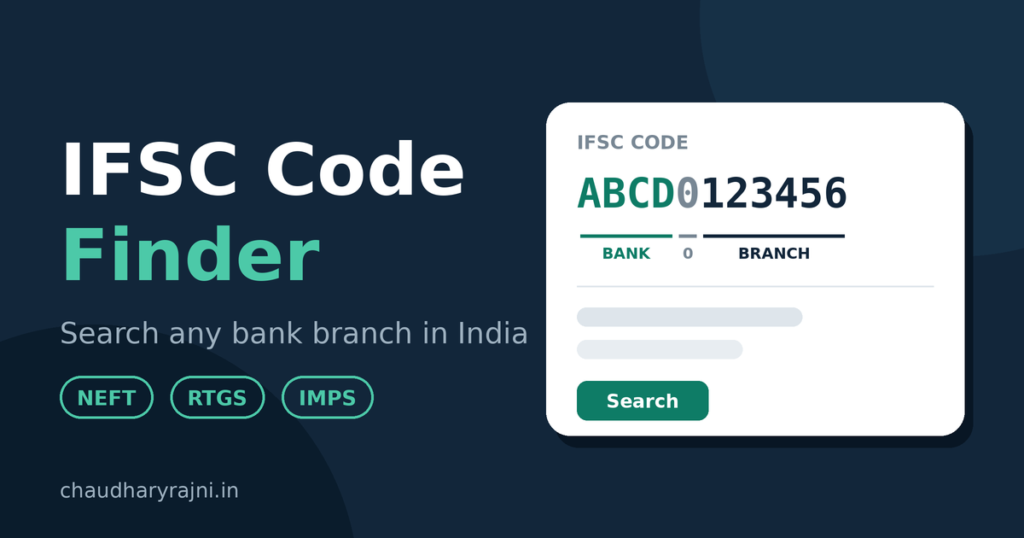
“What Is an IFSC Code?”
An IFSC (Indian Financial System Code) is an 11-character alphanumeric code used to identify a bank branch for electronic fund transfers in India, including NEFT, RTGS, and IMPS.
How to read an IFSC code:
- First 4 characters: Identify the bank.
- 5th character: Always
0in a standard IFSC code; it is reserved for future use. - Last 6 characters: Identify the specific bank branch.
For example, in HDFC0005179, HDFC identifies the bank, 0 is the fifth character, and 005179 identifies the branch within the bank’s IFSC system.
You can also explore our Free Online Calculators to calculate EMI, FD interest, recurring deposits, and more.
Our free IFSC Code Finder helps you look up publicly available bank branch information in a few simple steps.
Search by bank and branch
- Select your bank from the bank dropdown.
- Choose the state where the branch is located.
- Select the district and branch from the available options.
- Review the displayed IFSC code, branch address, MICR code, and other available details.
Search directly by IFSC code
If you already know the IFSC code, enter it in the direct search field and click Search. The tool will look for a matching record in its available dataset.
Check the details before transferring money
Always compare the branch details with your bank’s official website, passbook, cheque book, or banking app before initiating a transfer. If a code is not found or the details look outdated, contact the bank directly.
Difference Between IFSC Code and MICR Code
IFSC and MICR codes serve different purposes in the Indian banking system. Both help identify banking information, but they are used in different ways.
IFSC Code
- Contains 11 letters and numbers.
- Identifies a bank branch for electronic fund transfers such as NEFT, RTGS, and IMPS.
- Can usually be found in a bank’s official branch details, passbook, cheque book, or banking app.
MICR Code
- Contains 9 digits.
- Is primarily used to identify a bank branch for cheque processing.
- Is commonly printed on cheques issued by banks.
Important: IFSC and MICR are not interchangeable. If you are making an electronic transfer, use the IFSC requested by your bank and verify the beneficiary’s account details before confirming the transaction.
For official banking information and regulatory updates, visit the Reserve Bank of India (RBI).
Frequently Asked Questions (FAQs)
1. What is an IFSC code?
An IFSC code is an 11-character code used to identify a specific bank branch for electronic fund transfers in India.
2. How can I find my bank’s IFSC code?
You can use this free IFSC Finder to search by bank, state, district, and branch, or enter an IFSC code directly.
3. Is an IFSC code the same as a MICR code?
No. An IFSC code identifies a bank branch for electronic transfers, while a MICR code is a 9-digit code used mainly for cheque processing.
4. Can two bank branches have the same IFSC code?
IFSC codes are assigned to identify bank branches. Always check the exact code with your bank, especially if a branch has moved, merged, or changed its details.
5. Can an IFSC code change?
Yes. A code or branch detail may change following a bank’s administrative changes, merger, or branch restructuring. Confirm the latest details with your bank.
6. Is it safe to share an IFSC code?
An IFSC code is not a password or PIN. However, before transferring money, verify the beneficiary’s account details and bank information carefully.