
RD Calculator
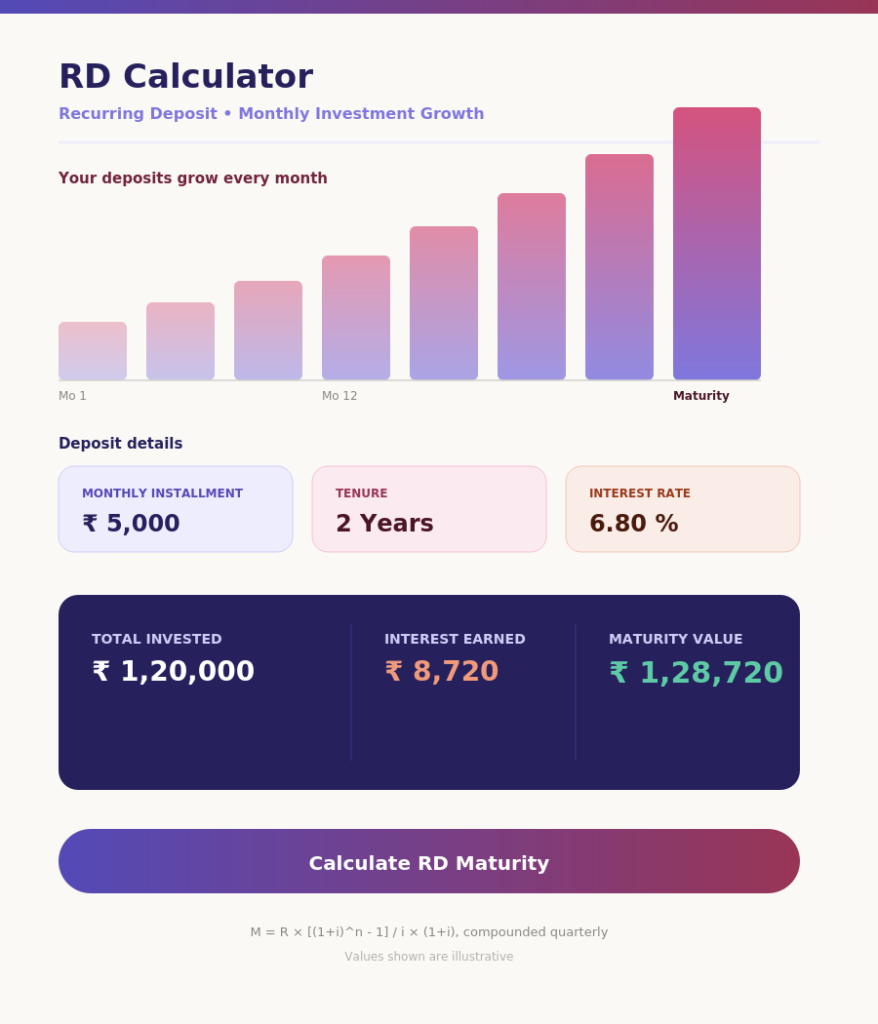
A Recurring Deposit (RD) is a simple way to save a fixed amount of money regularly and earn interest over a specific period. Unlike a Fixed Deposit, where you usually invest a lump sum amount at one time, an RD allows you to deposit a fixed amount every month.
Our RD Calculator helps you estimate your total investment, total interest, and maturity amount based on your monthly deposit, interest rate, and RD tenure. You can enter the amount you want to save each month, choose the applicable interest rate, and select your investment period to get an estimated maturity amount.
For example, if you deposit ₹5,000 every month for five years, your total deposits will be ₹3,00,000. The calculator can then estimate how much interest you may earn and the approximate amount you may receive at maturity.
The result is provided for financial planning purposes. The actual maturity amount may vary depending on the bank, interest rate, calculation method, deposit dates, RD terms, and other applicable conditions. For more useful financial and planning tools, explore our Online Calculators page.
RD Calculator
Calculate your recurring deposit maturity amount, total interest, and total investment.
Note: This calculator provides an estimated RD maturity amount. Actual returns may vary depending on the bank’s interest rate, compounding method, deposit dates, tenure, and other applicable terms.
What Is an RD Calculator?
An RD Calculator is an online tool that helps you estimate how much money you may receive when your Recurring Deposit matures. It uses information such as your monthly deposit amount, annual interest rate, and investment tenure to calculate the estimated total investment, interest earned, and maturity amount.
For example, suppose you deposit ₹5,000 every month for five years at an annual interest rate of 7%. Your total deposits over 60 months would be ₹3,00,000. The RD Calculator can estimate the interest earned on these regular deposits and show the approximate maturity amount.
Using an RD Calculator before opening an account can help you understand how different monthly deposits, interest rates, and tenures may affect your savings. You can change the inputs and compare different scenarios without performing the calculations manually.
However, the result should be treated as an estimate. Banks may use their own RD interest calculation methods, deposit-date conventions, and applicable terms. Always check the latest details with the bank before opening an RD.
How to Use This RD Calculator
Using this RD Calculator is simple. You only need to enter your monthly deposit, interest rate, and investment tenure to estimate your RD maturity amount.
1. Enter Your Monthly Deposit
Enter the amount you plan to deposit every month. For example, if you want to save ₹5,000 every month, enter 5000 in the Monthly Deposit Amount field.
2. Enter the Annual Interest Rate
Enter the annual interest rate offered on the RD. For example, if the applicable rate is 7%, enter 7.
Interest rates can vary between banks, account types, customer categories, and tenure periods, so use the rate applicable to the RD you are considering.
3. Select the RD Tenure
Enter the number of years and any additional months for your RD. For example, a five-year RD can be entered as 5 years and 0 months.
4. Click “Calculate RD”
After entering all the details, click the Calculate RD button. The calculator will estimate your total investment, total interest, and maturity amount.
5. Understand the Results
The calculator shows three main figures:
- Total Investment: The total amount you deposit throughout the RD tenure.
- Total Interest: The estimated interest earned on your regular deposits.
- Maturity Amount: The estimated amount you may receive when the RD matures.
For example, a monthly deposit of ₹5,000 for 60 months means your total investment is ₹3,00,000. The interest and maturity amount will depend on the interest rate and calculation method used.
RD Maturity Amount Formula
The maturity amount of a Recurring Deposit depends on the amount deposited every month, the interest rate, the tenure, and the method used to calculate interest.
Unlike an FD, where the entire principal is invested at the beginning, an RD consists of multiple monthly deposits. Each installment earns interest for a different period because the deposits are made at different times.
A commonly used approach for estimating RD maturity is to calculate the interest earned by each monthly installment based on the remaining investment period and the applicable interest rate.
In simple terms:
Maturity Amount = Total Deposits + Estimated Interest
Where:
- Total Deposits = Monthly Deposit × Number of Months
- Estimated Interest = Interest earned on the monthly installments during the RD tenure
- Maturity Amount = Total Deposits + Estimated Interest
Example
Suppose you deposit ₹5,000 every month for 5 years at an annual interest rate of 7%.
Your total deposits would be:
₹5,000 × 60 months = ₹3,00,000
The RD Calculator then estimates the interest earned on these monthly deposits and adds it to your total investment to calculate the approximate maturity amount.
The exact maturity amount may differ from the calculator's estimate because banks can use different interest calculation methods, deposit dates, compounding conventions, and RD terms. Therefore, use the result as an estimate and verify the final amount with the bank before opening an RD.
RD Calculation Example
Let's understand how an RD works with a simple example.
Suppose you want to deposit ₹5,000 every month into an RD for 5 years at an annual interest rate of 7%.
Your investment details would be:
- Monthly Deposit: ₹5,000
- Annual Interest Rate: 7%
- RD Tenure: 5 years
- Number of Monthly Deposits: 60
- Total Investment: ₹3,00,000
Because you make a deposit every month, each installment earns interest for a different length of time. The first installment remains invested for the longest period, while the final installment earns interest for a much shorter period.
The RD Calculator uses these inputs to estimate the interest earned over the complete tenure and adds the estimated interest to your total deposits to calculate the maturity amount.
For planning purposes, this makes it easier to understand how much you could accumulate by saving a fixed amount every month.
Keep in mind that the actual maturity amount offered by a bank can differ from the calculator's estimate because banks may follow their own interest calculation methods, deposit-date rules, and applicable RD terms.
Factors That Affect RD Returns
The amount you receive when your RD matures depends on several factors. Understanding these factors can help you plan your regular savings more effectively.
1. Monthly Deposit Amount
Your monthly deposit directly affects your total investment. A higher monthly deposit means you contribute more money throughout the RD tenure, which can increase the potential maturity amount.
For example, depositing ₹5,000 every month for five years means investing ₹3,00,000. If you increase the monthly deposit, your total investment will also increase.
2. Interest Rate
The interest rate determines how much interest your deposits can earn. When other factors remain the same, a higher interest rate can result in higher interest earnings.
However, RD interest rates can vary between banks and may depend on the selected tenure and other account terms.
3. RD Tenure
The length of your RD also affects the final amount. A longer tenure generally gives your deposits more time to earn interest, although the actual benefit depends on the interest rate and the bank's RD terms.
4. Timing of Monthly Deposits
RD deposits are made regularly, so the timing of each installment matters when calculating interest. Earlier installments generally remain invested for a longer period than later installments.
This is one reason RD calculations are different from FD calculations.
5. Bank's Calculation Method
Banks may follow specific methods for calculating RD interest, including their compounding frequency and rules related to deposit dates. Therefore, the maturity amount shown by an online calculator may not exactly match the amount quoted by a particular bank.
Always check the bank's latest RD terms before opening an account.
RD vs FD – What Is the Difference?
Recurring Deposit (RD) and Fixed Deposit (FD) are both commonly used savings options, but they work differently. The main difference is how you deposit the money.
With an FD, you generally invest a lump sum amount at one time for a fixed period. With an RD, you deposit a fixed amount regularly, usually every month.
| Feature | RD | FD |
|---|---|---|
| Investment method | Regular monthly deposits | One-time lump-sum deposit |
| Example | ₹5,000 every month | ₹1,00,000 once |
| Regular contribution | Yes | No |
| Suitable for | Regular monthly saving | Investing an available lump sum |
| Interest calculation | Based on regular installments | Based on the deposited principal and applicable terms |
For example, if you can save ₹5,000 every month, an RD allows you to build your savings gradually. If you already have ₹1,00,000 available and want to invest it for a fixed period, an FD may be a more relevant option to consider.
If you want to estimate the maturity amount and interest on a lump-sum deposit, you can also use our FD Calculator.
Both products have different terms and interest calculation methods, so check the latest rates and conditions offered by the bank before making a decision.
Benefits of Using an RD Calculator
An RD Calculator can make it easier to understand how regular monthly savings may grow over time. Instead of calculating interest manually, you can enter a few details and get an estimated result within seconds.
1. Estimate Your Maturity Amount
The calculator gives you an estimate of the amount you may receive when the RD matures. This can help you understand the potential outcome of your regular savings.
2. Know Your Total Investment
You can quickly see how much money you will deposit throughout the RD tenure. For example, a monthly deposit of ₹5,000 for 60 months means a total investment of ₹3,00,000.
3. Estimate Your Interest Earnings
The calculator separates your total investment from the estimated interest. This helps you understand how much your savings could potentially earn over the selected period.
4. Compare Different Saving Scenarios
You can change the monthly deposit, interest rate, or tenure and compare different scenarios. For example, you can check how the estimated maturity amount changes when you increase your monthly deposit.
5. Save Time
Manual RD calculations can be complicated because each monthly installment is invested for a different period. An online calculator performs the calculation quickly and reduces the need for manual calculations.
6. Plan Regular Savings
Knowing the estimated investment and maturity amount can help you plan how much you may want to save each month according to your financial goals.
The results are estimates for planning purposes. Always verify the actual interest rate, maturity amount, and terms with the bank before opening an RD.
If you are planning for long-term savings, you can also use our PPF Calculator to estimate your total investment, interest, and maturity amount.
Things to Check Before Opening an RD
Before opening a Recurring Deposit, it is important to understand the account terms and conditions. The calculator can help you estimate returns, but the bank's actual terms should be your final reference.
1. Current Interest Rate
Check the current RD interest rate offered by the bank for your chosen tenure. Interest rates can vary depending on the bank, tenure, and customer category.
2. RD Tenure
Choose a tenure that matches your savings goal. Check the minimum and maximum tenure available with the bank before opening the account.
3. Monthly Deposit Amount
Make sure the monthly deposit is affordable for your regular budget. Missing or delaying installments may result in charges or other consequences according to the bank's rules.
4. Premature Closure Rules
Check what happens if you need to close the RD before its maturity date. The interest payable and applicable charges may differ from the original terms.
5. Missed Installment Rules
Understand the bank's rules regarding missed or delayed monthly deposits. Some banks may charge a penalty or apply other conditions.
6. Maturity and Renewal Terms
Check how the bank handles the account when the RD reaches maturity and whether any automatic renewal option is available.
7. Tax and Other Applicable Rules
RD interest may have tax implications depending on your circumstances and the applicable tax rules. Check the latest official information or consult a qualified tax professional if needed.
Before opening an RD, compare the applicable terms carefully and confirm the latest details directly with the bank or financial institution. For official information about banking regulations and applicable guidelines, you can also visit the Reserve Bank of India (RBI) website.
RD Calculator vs Manual Calculation
Calculating RD maturity manually can be difficult because an RD consists of multiple monthly deposits. Each installment is made at a different time and therefore earns interest for a different period.
An RD Calculator simplifies this process by using the monthly deposit, interest rate, and tenure to estimate the total investment, interest, and maturity amount.
Manual Calculation
With manual calculation, you need to consider each monthly installment and the period for which it earns interest. This can become time-consuming, especially when the RD tenure is several years long.
Using an RD Calculator
With an online calculator, you only need to enter your monthly deposit, annual interest rate, and tenure. The calculator then provides an estimated result within seconds.
This makes it easier to:
- Estimate your maturity amount
- Calculate total investment
- Understand potential interest earnings
- Compare different monthly saving amounts
- Plan your savings more conveniently
The calculator is designed for quick estimates and financial planning. For the exact maturity amount, always refer to the terms and calculation provided by your bank.
RD Calculator FAQs
What is an RD Calculator?
An RD Calculator is an online tool that estimates the total investment, interest earned, and maturity amount of a Recurring Deposit based on the monthly deposit, interest rate, and tenure.
How is RD maturity calculated?
RD maturity depends on the monthly deposits, applicable interest rate, tenure, and the bank's interest calculation method. Since each monthly installment is deposited at a different time, each installment earns interest for a different period.
How much will I get if I deposit ₹5,000 per month for 5 years?
A ₹5,000 monthly deposit for 5 years means you will deposit ₹3,00,000 in total. The final maturity amount will depend on the applicable interest rate and the bank's calculation method.
Can I use the RD Calculator for different tenures?
Yes. You can change the number of years and additional months to estimate the maturity amount for different RD periods.
Can I change the monthly deposit amount?
Yes. You can enter different monthly deposit amounts to compare how your estimated investment and maturity amount may change.
Is the RD Calculator accurate?
The calculator provides an estimate based on the information you enter. The actual maturity amount may differ because banks may use specific interest calculation methods, deposit-date rules, and account terms.
Is RD better than FD?
RD and FD work differently. An RD involves regular deposits, while an FD generally involves a one-time lump-sum deposit. The more suitable option depends on your available funds, savings pattern, financial goals, and the terms offered by the bank.
Can I calculate FD returns with this calculator?
No. This calculator is designed for recurring deposits. If you want to estimate the maturity amount of a lump-sum fixed deposit, you can use our FD Calculator.
What happens if I miss an RD installment?
The consequences depend on the bank's rules. There may be a late-payment charge or other conditions. Check the terms of your RD before opening the account.
Is RD interest taxable?
RD interest may have tax implications depending on applicable tax rules and your individual circumstances. Check the latest official tax rules or consult a qualified tax professional for guidance.
RD Calculator Disclaimer
This RD Calculator is provided for educational and financial planning purposes only. The results are estimates based on the information entered and should not be considered a guaranteed return.
The actual maturity amount may vary depending on the bank's interest rate, interest calculation method, deposit dates, RD tenure, missed or delayed installments, premature closure rules, tax treatment, and other applicable terms.
Before opening a Recurring Deposit, verify the latest interest rate, maturity amount, and account terms directly with the bank or financial institution.