
Starting a dropshipping business can look simple from the outside. You choose products, put them in an online store, find customers and place orders with a supplier.
But running a successful dropshipping business involves much more than putting products online.
You need to understand your customers, choose products carefully, work with reliable suppliers, price your products properly and provide a good buying experience.
Dropshipping can also have challenges. Competition can be high, profit margins may be limited, shipping can take time and you have less control over the product because the supplier handles fulfilment.
That does not mean dropshipping cannot work.
It means you need to approach it like a real business instead of looking for a quick way to make money.
In this guide, we will look at 10 practical ways to succeed in dropshipping, especially if you are a beginner. The focus is on choosing the right products, understanding customers, building trust, managing costs and creating a business that can grow over time.
Important: Dropshipping involves business and financial risks. There is no guaranteed income or guaranteed profit. Your results will depend on factors such as product demand, competition, costs, marketing, supplier performance and how well you manage the business.
1. Choose the Right Dropshipping Niche
One of the first decisions you need to make is choosing a niche.
A niche is a specific category or market that your store focuses on.
Instead of trying to sell everything to everyone, choosing a clear niche can make it easier to understand your target customers and create relevant content and marketing.
For example, a store might focus on:
- Home organisation products
- Pet accessories
- Fitness accessories
- Travel products
- Kitchen tools
- Beauty accessories
- Office and study products
The best niche is not necessarily the one that looks popular on social media.
You need to look at whether people actually have a reason to buy the products, whether there is enough demand and whether you can compete with existing sellers.
Look for Problems You Can Solve
A useful way to find products is to think about problems rather than trends.
Ask yourself:
What problem does this product solve?
Products that make a task easier, save time, improve convenience or solve a common problem can have a clear reason for customers to buy them.
This does not guarantee sales, but it gives you a stronger starting point than choosing a product simply because it is trending.
2. Research Your Products Before Selling Them
Choosing a niche is only the beginning.
You also need to research individual products before adding them to your store.
Look at:
- Product demand
- Selling price
- Supplier price
- Shipping cost
- Delivery time
- Product quality
- Customer reviews
- Competition
- Return possibilities
- Potential profit margin
Do not choose a product only because it has a low supplier price.
A cheap product can become expensive to sell if shipping costs are high, customers frequently return it or the quality creates complaints.
Try to understand the complete cost before deciding whether a product makes sense for your store.
3. Find a Reliable Supplier
Your supplier is an important part of your dropshipping business.
You may be responsible for marketing and customer service, but the supplier generally handles product fulfilment and shipping.
If the supplier sends poor-quality products, ships late or provides incorrect items, your customers may blame your store.
Before working seriously with a supplier, check:
- Product quality
- Reviews and ratings
- Processing time
- Shipping options
- Communication
- Return policy
- Product availability
- Packaging
- Order tracking
If possible, order a sample yourself.
This allows you to see the product quality and understand the actual customer experience before sending the product to buyers.
4. Know Your Target Customer
A common mistake beginners make is trying to sell to everyone.
Your store should have a clear idea of who the product is meant for.
Think about your potential customer:
- What age group are they in?
- What problem are they trying to solve?
- What type of products do they usually buy?
- What price are they comfortable paying?
- Where do they spend time online?
- What would make them trust a new store?
The better you understand your customer, the easier it becomes to create useful product descriptions, advertisements and content.
For example, a product designed for busy parents may need very different marketing from a product designed for college students.
You are not simply selling a product.
You are trying to show a particular customer why that product may be useful to them.
5. Build a Store That Looks Trustworthy
A customer may discover your product through an advertisement or social media post, but your website is where they decide whether to buy.
A professional-looking store can help create confidence.
Your website should have:
- Clear product photos
- Simple product descriptions
- Easy navigation
- Visible pricing
- Shipping information
- Return and refund information
- Contact details
- Secure payment options
- Mobile-friendly design
Avoid filling every page with pop-ups, excessive animations or unnecessary information.
A clean and simple store is often easier for customers to understand.
Write Product Descriptions for People
Do not simply copy the supplier’s product description.
Write your own description in clear language.
Explain:
- What the product does
- Who it is useful for
- Its important features
- Its size or specifications
- How it can be used
- What customers should know before buying
Good product descriptions answer the questions a customer is likely to have before placing an order.
6. Price Your Products Carefully
Pricing is one of the most important parts of a dropshipping business.
Your selling price needs to cover more than the supplier’s product cost.
Depending on your business model, you may also have expenses such as:
- Shipping
- Payment processing
- Advertising
- Website costs
- Platform fees
- Returns and refunds
- Customer support
- Taxes and other business expenses
For example, if a product costs you ₹500 from the supplier, selling it for ₹600 does not automatically mean you have made ₹100 profit.
If you spend money on advertising and other costs, your actual profit could be much lower.
Before setting a price, calculate the total cost of selling the product.
Your goal should be to create a price that customers can accept while leaving enough room to cover your expenses and generate a reasonable profit.
7. Start Marketing Before Expecting Sales
A good product does not automatically attract customers.
People need to discover it first.
This is where marketing becomes important.
Depending on your target audience and budget, you can explore channels such as:
- YouTube
- Search engines
- Influencer marketing
- Email marketing
- Paid advertising
You do not need to use every platform from day one.
It is usually better to understand one or two channels properly and learn what works for your audience.
Create Useful Content
Marketing does not always have to be a direct sales pitch.
You can create content that shows the product being used, answers common questions, compares options or demonstrates how it solves a problem.
Useful content can help potential customers understand why they should consider the product.
It can also help build trust before someone makes a purchase.
8. Test Before Spending a Large Advertising Budget
Paid advertising can help a new store reach customers, but it can also become expensive quickly.
Do not assume that an advertisement will be profitable simply because it receives clicks.
You need to look at what happens after the click.
For example:
Ad → Website visit → Product view → Add to cart → Purchase
If many people click but nobody buys, the problem may not be the advertisement.
The product, price, website, shipping information or customer trust may need improvement.
Start with a controlled budget that you can afford to lose while testing.
Study the results and make changes based on actual data rather than emotions.
9. Provide Excellent Customer Service
Customer service can make a major difference in an online business.
Customers may have questions about shipping, product details, payments, returns or delivery times.
Responding clearly and professionally can help build trust.
If something goes wrong, communicate honestly.
For example, if a shipment is delayed, ignoring the customer will usually make the situation worse.
Keep customers informed and explain what you can do to resolve the problem.
Remember that the customer may not know who your supplier is.
From their perspective, they bought from your store, so you are responsible for their overall buying experience.
10. Track Results and Improve the Business
Dropshipping is not something you set up once and then leave alone.
You need to understand what is working and what is not.
Track useful numbers such as:
- Website visitors
- Product views
- Add-to-cart rate
- Conversion rate
- Advertising cost
- Average order value
- Refunds and returns
- Customer acquisition cost
- Profit after expenses
These numbers can help you make better decisions.
If one product receives plenty of attention but very few purchases, investigate why.
If another product consistently generates profitable sales, you may want to focus more attention on it.
The goal is to learn from the data and improve the business over time.
How the Dropshipping Business Model Actually Works
Before starting a dropshipping business, it is important to understand how the process works.
In a traditional retail business, the seller usually purchases inventory in advance and stores the products before selling them.
Dropshipping works differently.
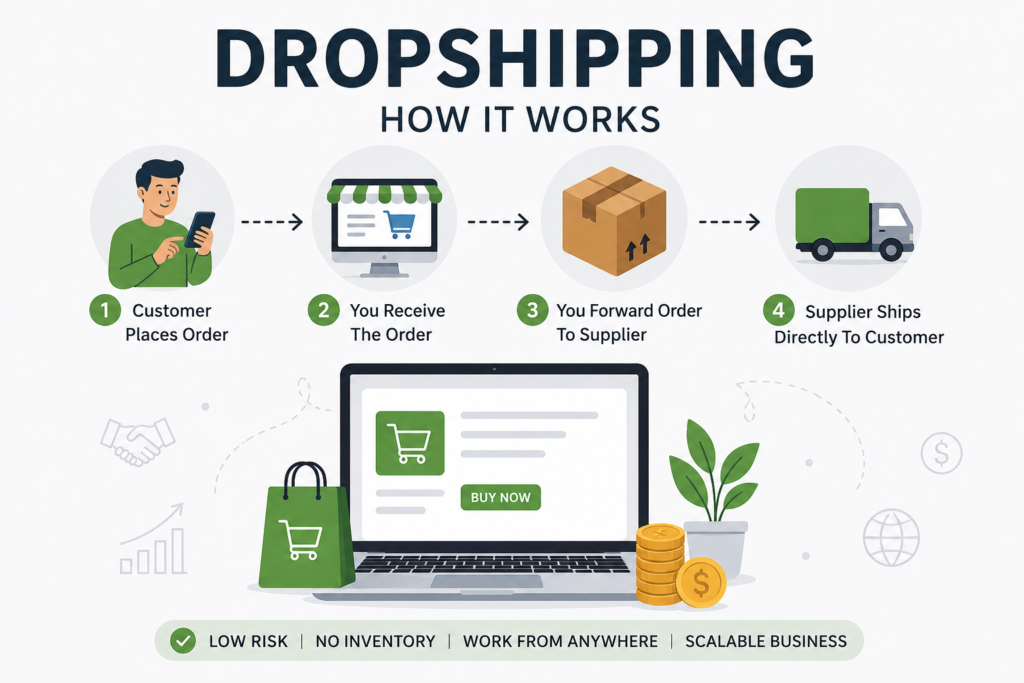
The store displays products for customers to purchase, but the seller does not necessarily keep those products in their own warehouse. After a customer places an order, the seller passes the order details to a supplier, who then fulfils and ships the product to the customer.
A simple example looks like this:
Customer places an order → You receive the payment → You place the order with the supplier → Supplier ships the product → Customer receives the order
This sounds straightforward, but there are several responsibilities in between.
You still need to manage your website, marketing, pricing, customer communication, refunds and overall customer experience.
The supplier may handle fulfilment, but the customer generally sees your store as the business they purchased from.
That is why choosing the right supplier is so important.
How to Calculate Your Real Dropshipping Profit
One of the biggest mistakes beginners make is confusing sales revenue with profit.
Suppose you sell a product for ₹1,500.
Your supplier charges ₹700.
It may look like you have ₹800 left.
But there may be other costs:
- Shipping
- Payment processing
- Advertising
- Website expenses
- Refunds
- Discounts
- Taxes and other business costs
After all these expenses, your actual profit may be much lower.
A simple way to think about it is:
Selling price − product cost − shipping − marketing − other business costs = actual profit
You do not need complicated accounting when starting out, but you should understand your numbers before increasing your advertising budget.
A product that generates many sales but leaves very little profit may not be a good product for your business.
Revenue tells you how much money came in. Profit tells you what was left after expenses.
That difference is extremely important.
Local vs International Suppliers
Your supplier’s location can affect the customer experience.
An international supplier may offer a large selection of products, but shipping can sometimes take longer and may involve additional complications.
A local supplier may offer faster delivery for customers in the same country, although the product selection or pricing may be different.
There is no universal answer about which option is better.
Compare:
- Product quality
- Delivery time
- Shipping cost
- Return process
- Communication
- Inventory availability
- Total product cost
The cheapest supplier is not automatically the best supplier.
A slightly more expensive supplier that provides reliable delivery and better product quality may create a better customer experience and fewer problems.
Dropshipping in India: What Beginners Should Consider
If you are planning to operate a dropshipping business in India, do not treat it as simply a way to list products online.
You should understand the business side before spending money.
Depending on how you operate, you may need to consider issues such as business registration, taxation, payment processing, consumer protection, product restrictions and marketplace rules.
The exact requirements can vary depending on your business structure, products, sales channels and location.
This is one area where it is better to verify current requirements from official Indian sources or speak with a qualified professional rather than relying on random social-media advice.
Also remember that your selling price should account for the complete cost of doing business.
A product may look profitable on paper but become much less attractive after shipping, advertising, returns and other expenses are included.
How to Handle Returns and Refunds
Returns are a normal part of online selling.
Customers may receive a damaged product, receive the wrong item, change their mind or experience another problem.
Before launching your store, decide how returns and refunds will be handled.
Your policy should clearly explain:
- When a customer can request a return
- Who pays return shipping
- What condition the product must be in
- How refunds are processed
- What happens if the product arrives damaged
- How customers can contact you
Do not make delivery promises that you cannot reasonably meet.
For example, if your supplier normally takes two weeks to deliver a product, do not advertise it as a two-day delivery simply because it sounds more attractive.
Online sellers need a reasonable basis for shipping claims, and delays can create refund and customer-service problems.
A clear policy can prevent confusion and make it easier to handle difficult situations professionally.
Build Trust Before Asking for a Sale
A new online store has one major challenge:
Why should a customer trust you?
Customers may hesitate when they have never heard of your brand before.
You can build trust by providing:
- Clear product information
- Realistic delivery estimates
- Easy-to-find contact details
- Transparent return policies
- Secure payment options
- Helpful customer support
- Genuine product images where possible
- Honest marketing
Avoid exaggerated claims.
Do not tell customers that a product is “guaranteed to change your life” or promise unrealistic results simply to increase sales.
Trust may take time to build, but it can become one of your most valuable business assets.
Use SEO to Bring Free Organic Traffic
Paid advertising is not the only way to attract customers.
Search engine optimisation, or SEO, can help your store appear when people search for products or information related to your niche.
For example, instead of creating only a product page, you could publish useful content that answers questions your potential customers are searching for.
Depending on your niche, this could include:
- Buying guides
- Product comparisons
- How-to articles
- Product care guides
- Frequently asked questions
- Problem-solving articles
SEO usually takes time, so it should not be treated as an instant traffic source.
But useful content can continue attracting visitors after it is published.
The important thing is to create content for real users rather than filling pages with keywords.
Create a Simple 30-Day Action Plan
If you are a beginner, trying to do everything at once can become overwhelming.
A simple first-month plan can help.
Week 1: Research
Choose a niche and research potential products.
Study competitors, customer reviews, pricing and supplier options.
Week 2: Build
Set up your store, product pages, policies and basic customer-support system.
Make sure the website works properly on mobile devices.
Week 3: Test
Start creating content and test a small marketing campaign if your budget allows.
Do not assume your first advertisement will be profitable.
Use the results to learn.
Week 4: Improve
Look at your traffic, product views, customer questions, sales and costs.
Keep what works and improve what does not.
This first month should be about learning and testing, not expecting guaranteed income.
Be Careful With “Guaranteed Income” Claims
Dropshipping is often promoted online as an easy way to make passive income.
Be careful with such claims.
There is no guaranteed monthly income from dropshipping.
The FTC has taken action against online business opportunities that allegedly used unsupported promises of large or guaranteed earnings, including e-commerce opportunities.
This is an important lesson for beginners:
Do not build your business plan around someone else’s income screenshot or promise.
Study the actual costs, understand the risks and make decisions based on realistic numbers.
If someone is selling a course, service or business opportunity and making specific earnings claims, look for evidence rather than relying only on testimonials or social-media posts.
Think Long Term, Not Just About Quick Sales
A dropshipping store may start with one product, but building a sustainable business requires more than finding a product that sells for a few weeks.
Try to build a store that customers can recognise and trust.
Over time, you may be able to:
- Improve your website
- Build an email list
- Create useful content
- Develop a stronger brand
- Add related products
- Improve customer service
- Negotiate better supplier terms
- Reduce unnecessary costs
The long-term goal should be to build something that has value beyond a single trending product.
Dropshipping is only one way to build an online income stream. If you want to explore other ideas, read our guide on 12 Best Passive Income Ideas to Help You Earn ₹1 Lakh Every Month.
Common Dropshipping Mistakes to Avoid
Beginners often make mistakes because they focus too much on getting their first sale.
Some common mistakes include:
Choosing a Product Only Because It Is Trending
A trend can disappear quickly. Research the product and its potential customers before investing heavily.
Ignoring Shipping Times
Long or unclear delivery times can lead to complaints, refunds and unhappy customers.
Copying Competitors
Studying competitors can be useful, but copying their entire store does not create a strong business.
Spending Too Much on Ads Too Early
Advertising should be treated as a testing process. Do not spend money you cannot afford to lose.
Ignoring Customer Complaints
Negative feedback can reveal problems with your product, supplier or website.
Focusing Only on Revenue
High sales numbers do not necessarily mean high profits. Always look at the money left after your total business expenses.
Expecting Overnight Success
Dropshipping is still a business. It can take time to find the right products, customers and marketing strategy.
Final Thoughts
Dropshipping can be an accessible way to learn about online business because you do not necessarily need to maintain your own inventory.
But it is not a guaranteed way to make easy money.
Success depends on many factors, including product selection, supplier reliability, pricing, marketing, customer service and financial management.
Start small.
Research before spending.
Test your ideas.
Pay attention to your customers.
Track your numbers.
And most importantly, treat your store like a real business rather than a shortcut to quick income.
If you build good systems and keep improving them, you have a better chance of creating a dropshipping business that can grow over time.
Frequently Asked Questions
1. Is dropshipping still worth starting for beginners?
Dropshipping can still be a way to learn and operate an online business, but competition is high and there is no guaranteed income. Success depends on choosing the right products, controlling costs, finding reliable suppliers and reaching the right customers.
2. How much money do I need to start dropshipping?
There is no single fixed amount. Your costs can include a website, domain, marketing, product samples, payment processing and other business expenses. Starting with a small, controlled budget can help reduce unnecessary risk.
3. Can I start dropshipping without holding inventory?
Yes. In the traditional dropshipping model, the supplier holds the inventory and fulfils the customer’s order after a purchase is made. However, you still remain responsible for your store, customers and overall buying experience.
4. How do I find a good dropshipping product?
Look for products that solve a clear problem, have reasonable demand, can be shipped reliably and leave enough margin after all expenses. Research customer reviews and competitors before making a decision.
5. Is dropshipping passive income?
No. A dropshipping business normally requires ongoing work. You may need to manage marketing, customer service, suppliers, product research, orders and finances.
6. What is the biggest mistake beginners make in dropshipping?
One common mistake is focusing only on finding a trending product while ignoring the complete business model. Product quality, shipping, pricing, customer experience and profit after expenses are all important.
Disclaimer: This article is for general educational purposes only. It does not guarantee business success or income. Dropshipping results can vary depending on market conditions, competition, product demand, supplier reliability, marketing costs and other factors. Always research carefully and consider your own financial situation before starting a business or spending money on it.