
Introduction
Keyword Research for Beginners-Have you ever written a blog post that received little or no traffic, even though you spent hours creating it?
You’re not alone. Keyword research is an important SEO.
Many beginners believe that simply writing good content is enough to rank on Google. However, without understanding what people are actually searching for, even the best-written article can struggle to reach the right audience.
This is where keyword research becomes important.
Keyword research helps you discover the words and phrases people type into search engines when looking for information, products, or services. By understanding these search terms, you can create content that matches your audience’s needs and improves your chances of appearing in search results.
The good news is that keyword research is not as complicated as it may seem. You don’t need expensive software or years of experience to get started. With the right approach and a few free tools, anyone can learn how to find valuable keywords.
In this beginner-friendly guide, you’ll learn what keyword research is, why it matters, different types of keywords, how to find the best keywords step by step, common mistakes to avoid, and the best free tools to help you succeed.
Whether you’re a blogger, website owner, freelancer, or someone just beginning your SEO journey, this guide will help you build a strong foundation for creating content that people are already searching for.
Let’s get started!
What Is Keyword Research?
Keyword research is the process of finding the words and phrases that people type into search engines like Google when they are looking for information, products, or services.
These words and phrases are called keywords.
By understanding what your audience is searching for, you can create content that matches their needs. This increases the chances of your website appearing in search results and attracting the right visitors.
In simple words, keyword research helps you answer one important question:
“What does my audience want to know?”
Once you know the answer, you can create content that solves their problems and provides real value.
Why Is Keyword Research So Important?
Imagine opening a shop without knowing what customers want to buy.
You might fill your shelves with products that nobody is looking for.
The same thing happens in blogging.
If you write articles without researching keywords, you may spend hours creating content that very few people search for.
Keyword research helps you create articles based on actual search demand instead of guesswork.
Real-Life Example
Suppose you want to write an article about yoga.
Instead of choosing a broad topic like “Yoga”, keyword research may show that people are searching for:
-
- Best yoga for beginners
-
- Morning yoga routine at home
-
- Yoga for weight loss
-
- Yoga for back pain
Now you know exactly what readers are looking for, making it easier to create useful content.
Benefits of Keyword Research
Keyword research helps you:
-
- Understand what people are searching for.
-
- Create content that answers real questions.
-
- Attract targeted organic traffic.
-
- Improve your chances of ranking on Google.
-
- Plan your content strategy more effectively.
-
- Discover new blog post ideas.
Key Takeaway
Keyword research is the foundation of every successful SEO strategy.
Instead of guessing what people want, it helps you create content based on real search behavior, making your articles more useful for readers and more visible in search engines.
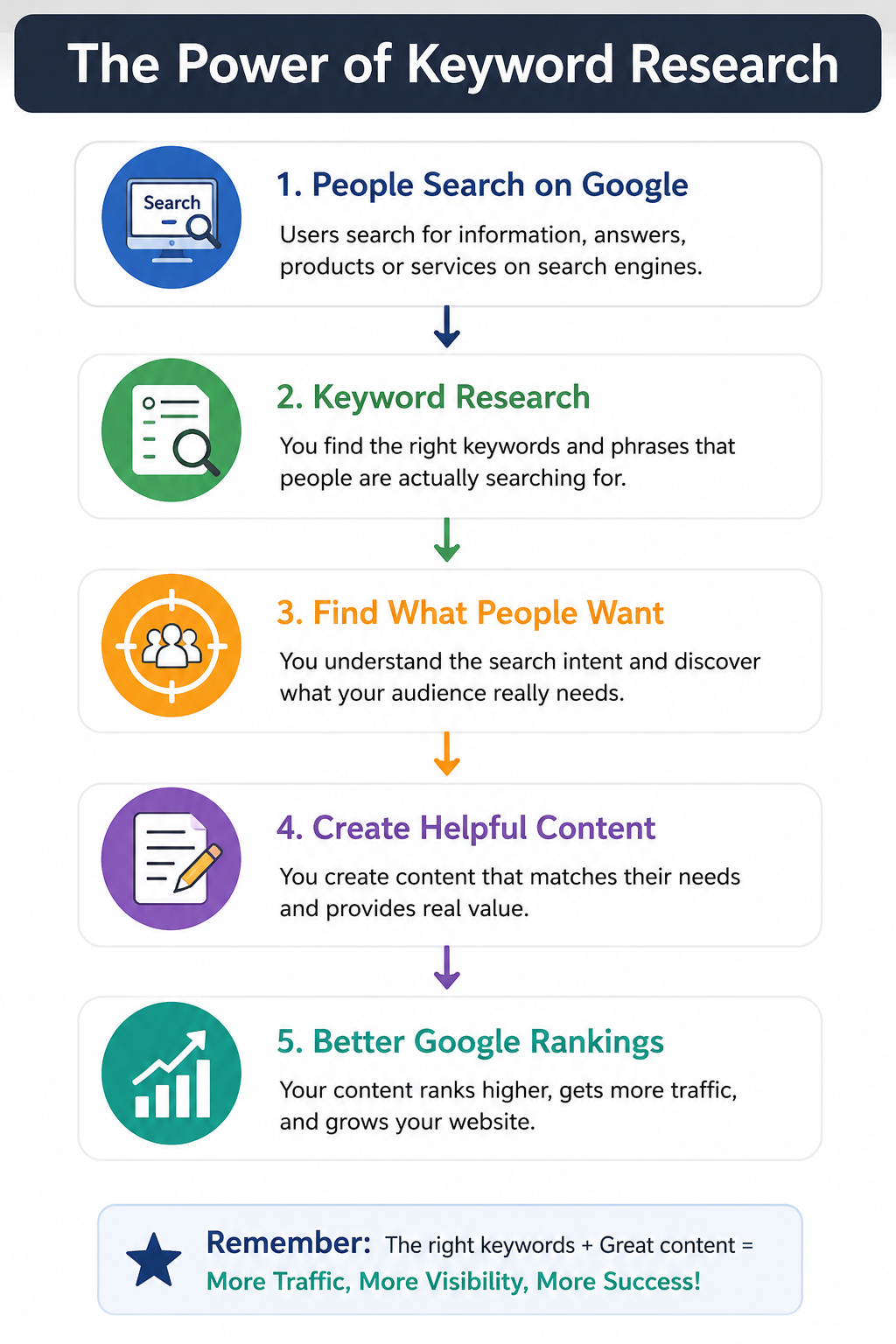
Why Is Keyword Research Important?
Many beginners make the mistake of writing articles without checking whether people are actually searching for the topic.
As a result, they spend hours creating content that receives very little traffic.
Keyword research helps you avoid this mistake.
It allows you to understand what your audience is searching for, how often they search for it, and what type of content they expect to find.
Instead of guessing, you make decisions based on real search data.
This not only improves your chances of ranking on Google but also helps you create content that genuinely solves people’s problems.
Here are the biggest benefits of keyword research:
1. It Helps You Understand Your Audience
Keyword research shows the exact words people use when searching online.
This helps you understand their questions, problems, and interests.
When you know what your audience wants, creating valuable content becomes much easier.
2. It Brings Targeted Organic Traffic
Not every visitor is the right visitor.
Choosing relevant keywords helps attract people who are already interested in your topic, product, or service.
This means higher-quality traffic and better engagement.
3. It Gives You Better Chances to Rank on Google
Writing about topics with real search demand increases your chances of appearing in search results.
Instead of competing for very broad keywords, beginners can target less competitive keywords and achieve better rankings.
4. It Helps You Plan Your Content Strategy
Keyword research provides hundreds of blog post ideas.
Instead of wondering what to write next, you can build your content calendar around topics people are already searching for.
5. It Saves Time and Effort
Creating an article takes time.
Keyword research ensures that your effort is focused on topics that have the potential to bring visitors instead of writing content nobody is searching for.
Real-Life Example
Imagine you own a website about healthy recipes.
Without keyword research, you might write an article titled:
Healthy Food
However, keyword research may reveal that people are actually searching for:
-
- Healthy breakfast ideas
-
- High-protein breakfast recipes
-
- Healthy dinner recipes for weight loss
By targeting these specific topics, your content becomes more useful and has a better chance of ranking.
My Tip 
Before writing any article, ask yourself:
“Are people actually searching for this topic?”
If the answer comes from keyword research instead of guesswork, you’re already one step ahead of many beginners.
Keyword research is not just about finding popular words.
It is about understanding your audience, creating content they genuinely need, and giving your website the best chance to grow through organic search.
Types of Keywords
Not all keywords are the same.
Some keywords are very broad, while others are highly specific. Some people search for information, while others are ready to buy a product or visit a particular website.
Understanding different types of keywords helps you choose the right keywords for the right purpose.
Let’s look at the most important keyword types every beginner should know.
1. Short-Tail Keywords
Short-tail keywords are usually 1–2 words long.
Examples:
-
- SEO
-
- Blogging
-
- Yoga
-
- Laptops
These keywords often have high search volume, but they are also very competitive.
For example, ranking for the keyword “SEO” is extremely difficult because many large websites are already targeting it.
Short-tail keywords are useful for understanding a broad topic, but beginners usually find it easier to target more specific keywords.
2. Long-Tail Keywords
Long-tail keywords are 3 or more words long and are much more specific.
Examples:
-
- What is SEO for beginners
-
- Best blogging platform for beginners
-
- Morning yoga routine for weight loss
-
- Best laptop under $600 for students
Long-tail keywords usually have:
-
- Lower competition
-
- More specific search intent
-
- Better chances of ranking
-
- Higher conversion potential
For new websites, long-tail keywords are often the best starting point.
Real-Life Example
Imagine you open a small bakery.
Competing for the keyword “cake” is like competing with every bakery in the city.
Competing for “eggless chocolate cake in Delhi” is much easier because the audience is more specific.
The same principle applies to SEO.
3. Informational Keywords
Informational keywords are used when people want to learn something.
Examples:
-
- What is keyword research
-
- How to do SEO
-
- Benefits of yoga
-
- How to start a blog
These keywords are excellent for blog posts, tutorials, guides, and educational content.
Most beginners should focus heavily on informational keywords because they help attract organic traffic and build trust.
4. Navigational Keywords
Navigational keywords are used when people want to find a specific website or brand.
Examples:
-
- Google Search Console
-
- YouTube Studio
-
- WordPress login
-
- Amazon India
Users already know where they want to go, so these keywords are less useful for attracting new visitors unless your brand is already well known.
5. Transactional Keywords
Transactional keywords are used when people are ready to take action, such as buying, subscribing, or signing up.
Examples:
-
- Buy SEO course
-
- Best hosting plan for bloggers
-
- Cheap domain registration
-
- SEO audit service
These keywords often have strong commercial intent and can be valuable for businesses, affiliate websites, or service providers.
6. Commercial Investigation Keywords
These keywords are used when people are researching before making a decision.
Examples:
-
- Best SEO tools for beginners
-
- Hostinger vs Bluehost
-
- Best blogging course in India
-
- Top AI tools for content writing
Users are not ready to buy immediately, but they are comparing options and gathering information.
These keywords can bring highly engaged visitors to your website.
Which Keywords Should Beginners Target?
If your website is new, focus primarily on:
-
- Long-tail keywords
-
- Informational keywords
-
- Low-competition search terms
For example, instead of targeting:
 SEO
SEO
Try:
 What is SEO for beginners
Instead of:
Keyword research
Try:
How to do keyword research for a new blog
This approach gives new websites a much better chance of appearing in search results.
Tip
When choosing a keyword, ask these three questions:
-
- Is the keyword relevant to my website?
-
- Can I create genuinely helpful content for it?
-
- Is the competition reasonable for a new website?
If the answer is yes to all three, the keyword is worth targeting.
Understanding keyword types helps you choose the right keywords for your content goals.
For beginners, long-tail informational keywords are usually the safest and most effective starting point because they have lower competition and clearly match what users are looking for.
How to Do Keyword Research Step by Step
Step 1: Understand Your Target Audience
Before you start searching for keywords, take a moment to think about your audience.
Ask yourself these questions:
-
- Who will read this article?
-
- What problems are they trying to solve?
-
- What questions might they ask on Google?
-
- What information are they looking for?
When you understand your audience, finding the right keywords becomes much easier.
Example
If your website is about fitness, your audience may search for:
-
- Home workout for beginners
-
- Weight loss exercises
-
- Best protein foods
-
- Morning workout routine
Instead of writing what you want, focus on what your audience wants to learn.
Always think like your reader, not like the writer. The best keywords come from understanding real people and their needs.
Step 2: Brainstorm Seed Keywords
Seed keywords are the basic words or phrases related to your topic.
They are the starting point of keyword research.
For example, if your website is about blogging, your seed keywords could be:
-
- Blogging
-
- SEO
-
- WordPress
-
- Content Writing
-
- Affiliate Marketing
If your website is about cooking, your seed keywords might be:
-
- Healthy Recipes
-
- Breakfast Ideas
-
- Dinner Recipes
-
- Weight Loss Meals
Once you have a list of seed keywords, you can use keyword research tools to discover hundreds of related keyword ideas.
Example
Seed Keyword: SEO
Related keywords:
-
- SEO for Beginners
-
- What Is SEO
-
- SEO Tips
-
- On-Page SEO
-
- Technical SEO
-
- Local SEO
-
- SEO Checklist
One seed keyword can generate dozens or even hundreds of content ideas.
Every successful keyword research process starts with two simple steps:
-
- Understand your audience.
-
- Create a list of relevant seed keywords.
These two steps provide a strong foundation before using keyword research tools.
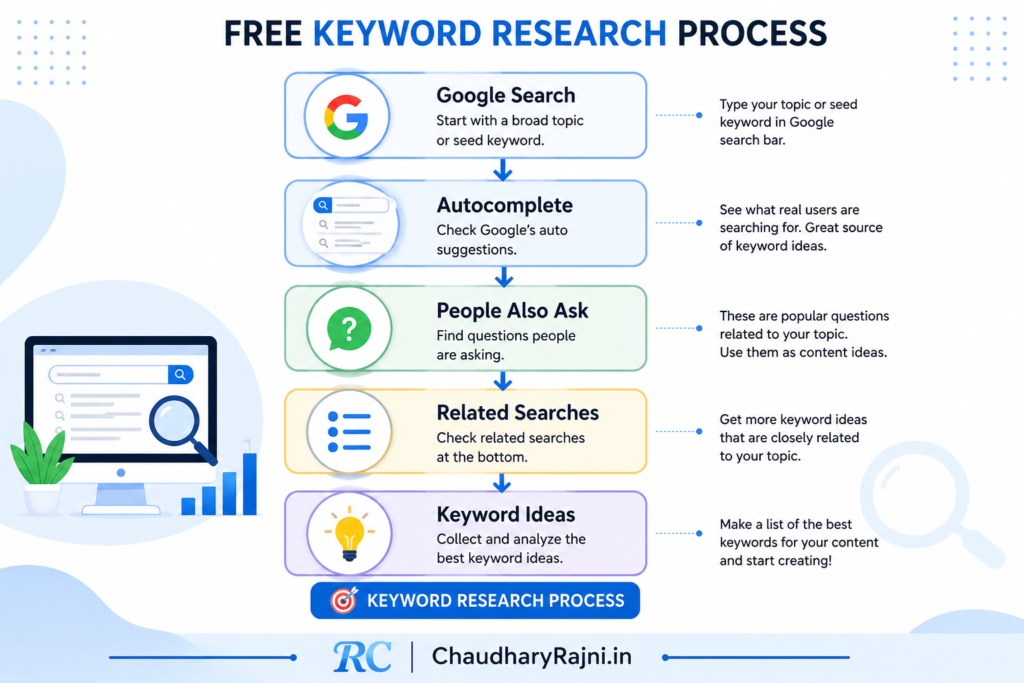
Step 3: Use Free Keyword Research Tools
You don’t need expensive SEO software to find good keywords.
Many free keyword research tools can help you discover what people are searching for on Google.
Let’s look at some of the best free tools every beginner should know.
1. Google Keyword Planner https://ads.google.com/home/tools/keyword-planner/
Google Keyword Planner is one of the most trusted keyword research tools.
It helps you discover keyword ideas, search volume, and related keywords directly from Google’s database.
It is an excellent starting point for beginners.
Best For:
-
- Finding keyword ideas
-
- Search volume
-
- Related keywords
2. Google Trends https://trends.google.com/
Google Trends shows whether a keyword is becoming more popular or losing interest over time.
It also helps you compare multiple keywords and identify trending topics.
Example:
Instead of guessing whether people search more for “AI Tools” or “SEO Tools,” Google Trends lets you compare both.
3. Google Search Autocomplete https://developers.google.com/search
Start typing a keyword into Google’s search bar.
Google will automatically suggest popular searches.
These suggestions come from real user searches and are excellent keyword ideas.
Example:
Type:
Keyword Research
Google may suggest:
-
- Keyword research for beginners
-
- Keyword research tools
-
- Keyword research checklist
-
- Keyword research free
4. People Also Ask
After searching on Google, you’ll often see a People Also Ask section.
These questions are valuable because they show what users genuinely want to know.
You can use these questions as headings in your article.
5. Related Searches
Scroll to the bottom of Google’s search results.
You’ll find Related Searches, which provide additional keyword ideas closely connected to your topic.
Tip
Don’t rely on just one tool.
Use Google Keyword Planner, Google Trends, Autocomplete, People Also Ask, and Related Searches together to discover better keyword opportunities.
Free keyword research tools provide valuable insights into what people are searching for.
By combining multiple tools, you can discover better keywords, understand search trends, and create content that matches your audience’s needs.
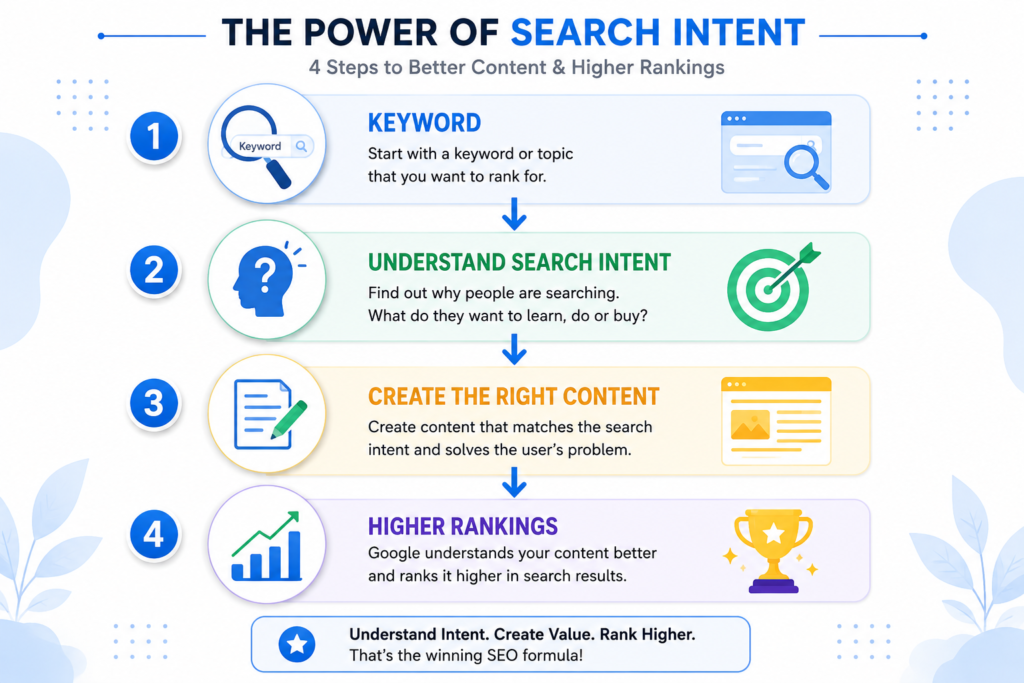
Step 4: Analyze Search Intent
Finding a keyword is only half the job.
To rank on Google, you also need to understand why people are searching for that keyword. This is called search intent.
Search intent simply means the goal behind a user’s search.
If your content matches the user’s intent, it has a much better chance of ranking.
The Four Main Types of Search Intent
1. Informational Intent
The user wants to learn something.
Examples:
-
- What is SEO?
-
- How to do keyword research?
-
- What is digital marketing?
 Best content: Blog posts, guides, tutorials.
2. Navigational Intent
The user wants to visit a specific website or page.
Examples:
-
- YouTube
-
- Gmail Login
-
- Google Search Console
Best content: Brand or website pages.
3. Commercial Intent
The user is comparing options before making a decision.
Examples:
-
- Best SEO tools
-
- Best laptops for students
-
- Ahrefs vs SEMrush
Best content: Comparison articles, reviews, buying guides.
4. Transactional Intent
The user is ready to take action.
Examples:
-
- Buy web hosting
-
- Purchase SEO course
-
- Buy domain name
Best content: Product pages, service pages, landing pages.
Real-Life Example
Suppose someone searches:
“Best keyword research tools”
They are looking for recommendations, not the definition of keyword research.
If your article only explains “What is Keyword Research?”, it may not satisfy their search intent.
That’s why understanding intent is just as important as choosing the keyword itself.
Tip
Before writing any article, search your target keyword on Google and check the top 10 results.
Ask yourself:
“What type of content is Google already ranking?”
This gives you a clear idea of what users expect.
Choosing the right keyword is important, but matching the search intent is what helps your content rank and satisfy readers.
Step 5: Check Keyword Difficulty
Finding a keyword with high search volume is exciting, but there’s one more thing you should always check before writing your article—Keyword Difficulty (KD).
Keyword Difficulty tells you how hard it is to rank for a particular keyword on Google.
The higher the difficulty score, the more competition you will face.
If your website is new, targeting very competitive keywords can make it difficult to appear on the first page of Google.
Why Is Keyword Difficulty Important?
Choosing keywords with lower competition gives new websites a better chance of ranking.
Instead of competing with large websites, you can focus on keywords that are easier to rank for and gradually build your website’s authority.
Example
Suppose you find these two keywords:
| Keyword | Difficulty |
|---|---|
| SEO | Very High |
| SEO for Beginners | Medium |
| SEO Tips for Small Business Owners | Low |
For a new website, “SEO Tips for Small Business Owners” is usually a smarter choice because it has lower competition and is more specific.
How to Check Keyword Difficulty
Many SEO tools provide a Keyword Difficulty score, including:
-
- Ahrefs
-
- SEMrush
-
- Ubersuggest
-
- Moz
-
- Mangools
Even if you don’t use paid tools, you can estimate competition by searching the keyword on Google and looking at the first-page results.
If you want to take keyword research beyond basic guesses, KWFinder can make the process much easier. Instead of choosing keywords only because they look popular, you can research search demand, SEO difficulty, trends, and competitor opportunities before deciding what to target.
For beginners, this can save a lot of time and help you focus on keywords that actually make sense for your website.
The goal isn’t to find the biggest keyword—it’s to find the right keyword for your content and your current level of SEO competition.
Find keywords with real search potential — Explore KWFinder
Check keyword difficulty before you spend hours writing — Try KWFinder
Discover better keyword opportunities and smarter content ideas — Explore KWFinder
Stop guessing what to write next — Start your keyword research with KWFinder
Ready to find smarter keyword opportunities? Check out KWFinder and see how it can help you plan your next piece of content with more confidence.
Ask yourself:
-
- Are big brands ranking?
-
- Are government or educational websites appearing?
-
- Are the articles well-written and detailed?
If yes, the keyword is likely more competitive.
Tip
Don’t always chase high-volume keywords.
For a new website, low-competition long-tail keywords often bring better results than broad, highly competitive keywords.
Keyword Difficulty helps you choose realistic keywords that match your website’s current strength.
For beginners, it’s better to build confidence by ranking for easier keywords before targeting highly competitive ones.
Step 6: Find Long-Tail Keywords
Long-tail keywords are longer and more specific search phrases that usually contain three or more words.
Although they often have lower search volume, they are easier to rank for and attract visitors who know exactly what they are looking for.
For beginners, long-tail keywords are one of the best ways to get organic traffic.
Why Are Long-Tail Keywords Important?
When people search using long-tail keywords, they usually have a clear purpose.
This means they are more likely to read your article, stay longer on your website, and take action.
Instead of targeting a broad keyword like:
SEO
Try targeting:
-
- SEO for Beginners
-
- SEO Tips for Small Businesses
-
- How to Learn SEO Step by Step
-
- Best Free SEO Tools for Beginners
These keywords are more specific and usually have less competition.
Real-Life Example
Imagine you own a recipe blog.
Instead of writing about:
Cake
You could target:
-
- Easy Chocolate Cake Recipe Without Oven
-
- Eggless Chocolate Cake for Beginners
-
- Birthday Cake Recipe at Home
These keywords match exactly what users are searching for.
How to Find Long-Tail Keywords
Here are some easy methods:
-
- Use Google Autocomplete.
-
- Check the People Also Ask section.
-
- Explore Related Searches at the bottom of Google.
-
- Use free tools like Google Keyword Planner and Ubersuggest.
-
- Look at questions people ask on forums and communities.
Tip
If your website is new, try to make 70–80% of your articles target long-tail keywords. This gives you a better chance of ranking faster and building steady organic traffic.
Long-tail keywords may have lower search volume, but they often bring more targeted visitors, less competition, and better ranking opportunities, making them an excellent choice for beginners.
Step 7: Analyze Your Competitors
One of the smartest ways to improve your keyword research is by analyzing your competitors.
This doesn’t mean copying their content. Instead, it means understanding what they are doing well and finding opportunities to create even better content.
By studying top-ranking websites, you can discover valuable keywords, content ideas, and SEO strategies.
Why Competitor Analysis Matters
Competitor research helps you:
-
- Discover keywords you may have missed.
-
- Understand what type of content ranks well.
-
- Learn how competitors structure their articles.
-
- Find content gaps that you can cover better.
How to Analyze Your Competitors
1. Search Your Target Keyword
Type your keyword into Google and look at the top 10 results.
2. Study Their Content
Notice:
-
- Article length
-
- Headings (H2 & H3)
-
- Images and infographics
-
- FAQs
-
- Internal linking
3. Find Content Gaps
Ask yourself:
-
- Can I explain this topic more clearly?
-
- Can I add better examples?
-
- Can I include updated information?
Your goal is to create more helpful content, not longer content.
Real-Life Example
Suppose you search “Keyword Research for Beginners.”
You notice that most articles explain keyword tools but don’t include practical examples.
You can improve your article by adding:
-
- Real-life examples
-
- Easy-to-follow screenshots
-
- Infographics
-
- Coach’s Tips
-
- Beginner-friendly language
This gives readers more value.
Tip
Never copy your competitors.
Instead, ask:
“How can I make my article more useful than theirs?”
Google rewards content that genuinely helps users.
Competitor analysis is about learning, not copying. By understanding what already works and adding your own value, you can create content that stands out and has a better chance of ranking.
Step 8: Choose the Right Keywords
After collecting a list of keywords, the final step is choosing the best ones for your content.
Not every keyword is worth targeting.
The best keywords are those that match your audience’s needs, have reasonable competition, and fit naturally within your article.
What Makes a Good Keyword?
Before selecting a keyword, ask yourself these questions:
-
- Is this keyword relevant to my topic?
-
- Does it match the user’s search intent?
-
- Is the competition suitable for my website?
-
- Can I create high-quality content around this keyword?
-
- Will this keyword provide value to my readers?
If the answer is yes, it’s a good keyword to target.
Example
Imagine you’re writing an article about blogging.
Instead of targeting:
Blogging
Choose a more specific keyword like:
-
- How to Start a Blog in India
-
- Blogging Tips for Beginners
-
- How to Make Money from Blogging
-
- Best Blogging Platforms for Beginners
These keywords are more focused and easier for a new website to rank for.
Build a Primary and Secondary Keyword List
For every article, you should have:
Primary Keyword
The main keyword you want your article to rank for.
Example:
Keyword Research for Beginners
Secondary Keywords
Supporting keywords related to the main topic.
Examples:
-
- What Is Keyword Research
-
- Free Keyword Research Tools
-
- SEO Keyword Research
-
- Long-Tail Keywords
-
- Keyword Research Guide
Using both primary and secondary keywords naturally makes your content more comprehensive.
Tip
Don’t choose a keyword just because it has high search volume.
Choose keywords that you can genuinely explain better than your competitors and that will help your readers.
Successful keyword research isn’t about collecting hundreds of keywords—it’s about selecting the right keywords that match your audience, your content, and your website’s current strength.
Quality always beats quantity.
Best Free Keyword Research Tools
You don’t need expensive SEO software to find great keywords.
Many free tools provide valuable keyword ideas, search trends, and content opportunities. These tools are perfect for beginners who want to improve their SEO without spending money.
Let’s explore some of the best free keyword research tools.
1. Google Keyword Planner
Google Keyword Planner is one of the most trusted keyword research tools because the data comes directly from Google.
Best For
-
- Finding keyword ideas
-
- Discovering search volume
-
- Planning SEO content
2. Google Trends
Google Trends helps you understand whether a keyword is gaining or losing popularity over time.
It is especially useful for identifying seasonal topics and trending searches.
Best For
-
- Trending topics
-
- Comparing keywords
-
- Seasonal content planning
3. Google Search Autocomplete
When you start typing in Google’s search box, it automatically suggests popular searches.
These suggestions are based on real user searches and are excellent sources of long-tail keywords.
Best For
-
- Long-tail keyword ideas
-
- Beginner keyword research
4. People Also Ask
Google’s People Also Ask section contains common questions users search for.
These questions can be used as headings in your article or to create FAQ sections.
Best For
-
- Blog headings
-
- FAQ ideas
-
- Understanding user intent
5. Related Searches
At the bottom of Google’s search results, you’ll find Related Searches.
These suggestions provide additional keyword ideas closely related to your main topic.
Best For
-
- Finding related keywords
-
- Expanding your content
Comparison Table
| Tool | Best For | Free |
|---|---|---|
| Google Keyword Planner | Search volume & keyword ideas | Yes |
| Google Trends | Trending topics | Yes |
| Google Autocomplete | Long-tail keywords | Yes |
| People Also Ask | User questions | Yes |
| Related Searches | Related keyword ideas | Yes |
Tip
You don’t need to use every tool every time.
For beginners, Google Autocomplete + People Also Ask + Google Trends are more than enough to discover excellent keyword ideas.
The best keyword research doesn’t always require paid software. By using Google’s free tools wisely, beginners can find valuable keywords, understand search intent, and create content that has a better chance of ranking.
Common Keyword Research Mistakes
Even experienced bloggers can make mistakes during keyword research. By avoiding these common errors, you can create more effective SEO content and improve your chances of ranking on Google.
1. Targeting Only High Search Volume Keywords
Many beginners believe that keywords with the highest search volume are always the best choice.
In reality, these keywords usually have very high competition, making them difficult for new websites to rank for.
Better Approach:
Focus on low-competition, long-tail keywords first.
2. Ignoring Search Intent
Choosing the right keyword is not enough.
If your content doesn’t match what users are looking for, it will struggle to rank.
Always create content that answers the user’s search intent.
3. Not Using Long-Tail Keywords
Many beginners only target broad keywords.
Long-tail keywords are more specific and often bring highly targeted visitors.
4. Keyword Stuffing
Adding the same keyword repeatedly makes your content unnatural and difficult to read.
Instead, use your primary keyword naturally and include related keywords where appropriate.
5. Skipping Competitor Analysis
Ignoring competitors means missing valuable opportunities.
Study top-ranking articles to understand what works and how you can create even better content.
6. Not Updating Keyword Research
Search trends change over time.
Review your keywords regularly and update your content to keep it relevant.
Tip
Write for people first, and optimize for search engines second.
Helpful content always performs better in the long run.
Successful keyword research is not just about finding keywords—it’s about choosing the right keywords, understanding your audience, and creating valuable content that genuinely helps readers.
Frequently Asked Questions (FAQs)
What is keyword research?
Why is keyword research important for SEO?
What are long-tail keywords?
Which free keyword research tools are best for beginners?
Google Keyword Planner
Google Trends
Google Search Autocomplete
People Also Ask
Related Searches
These tools can help you discover keyword ideas without spending money.
How many keywords should I use in one article?
Focus on one primary keyword and naturally include 3–6 related secondary keywords where they make sense. Avoid keyword stuffing.
Can I rank on Google using only free keyword research tools?
Many successful bloggers start with free tools. The key is to understand search intent, choose relevant keywords, and publish high-quality, helpful content consistently.
Tip
If you’re just starting your blogging journey, don’t try to target every keyword.
Start with one topic, one primary keyword, and create the best article possible. Consistency always beats shortcuts.
Conclusion
Keyword research is the foundation of every successful SEO strategy.
Instead of guessing what people want, it helps you create content based on real search behavior. By understanding your audience, choosing the right keywords, analyzing search intent, and using free keyword research tools, you can build content that attracts the right visitors and improves your chances of ranking on Google.
Remember, successful SEO is not about finding the most popular keywords—it’s about finding the right keywords that match your audience’s needs.
If you’re just starting, focus on long-tail keywords, create high-quality content, and stay consistent. Over time, these small efforts can lead to significant growth in your website’s organic traffic.
If you’re new to SEO, read our complete What Is SEO? A Powerful Beginner’s Guide to Better Rankings before applying keyword research techniques.
Key Points to Remember
Understand your target audience.
Choose the right keywords instead of chasing high search volume.
Focus on search intent.
Use free keyword research tools.
Target long-tail keywords.
Create helpful, high-quality content.
Keep updating your keyword strategy regularly.
Need to Action
Now it’s your turn!
Have you started using keyword research for your blog or website?
Share your experience or questions in the comments below. We’d love to hear from you.
If you found this guide helpful, don’t forget to share it with fellow bloggers, students, and anyone who wants to improve their SEO skills.
You may also like:
-
- On-Page SEO Guide for Beginners (Coming Soon)
-
- Technical SEO Explained (Coming Soon)