
Post Office savings schemes are widely used in India by people who want to save money through government-backed small savings products. These schemes include PPF, Sukanya Samriddhi Yojana, National Savings Certificate, Kisan Vikas Patra, Post Office Recurring Deposit and Monthly Income Scheme.
The Government of India reviews the interest rates on small savings schemes every quarter. For the October to December 2026 quarter, the interest rates have been kept unchanged. This means investors will continue to get the same rates that applied during the previous quarter.
Knowing the latest Post Office interest rates is important before starting a new investment or comparing different savings options. The interest rate can affect the amount you receive at maturity, the interest income you earn, and the overall value of your savings over time.
In this guide, we will explain the Post Office interest rates for October–December 2026 in simple language. We will cover PPF, Sukanya Samriddhi Yojana (SSY), NSC, KVP, Post Office RD, MIS and Post Office Time Deposit rates.
You will also find the tenure, basic investment requirements, interest calculation details and simple examples for different schemes. If you want to estimate your returns, you can also use the relevant calculators available on our website.
Whether you are comparing Post Office schemes for long-term savings or simply want to check the latest rates for October 2026, this guide will help you understand the current small savings rates in one place.
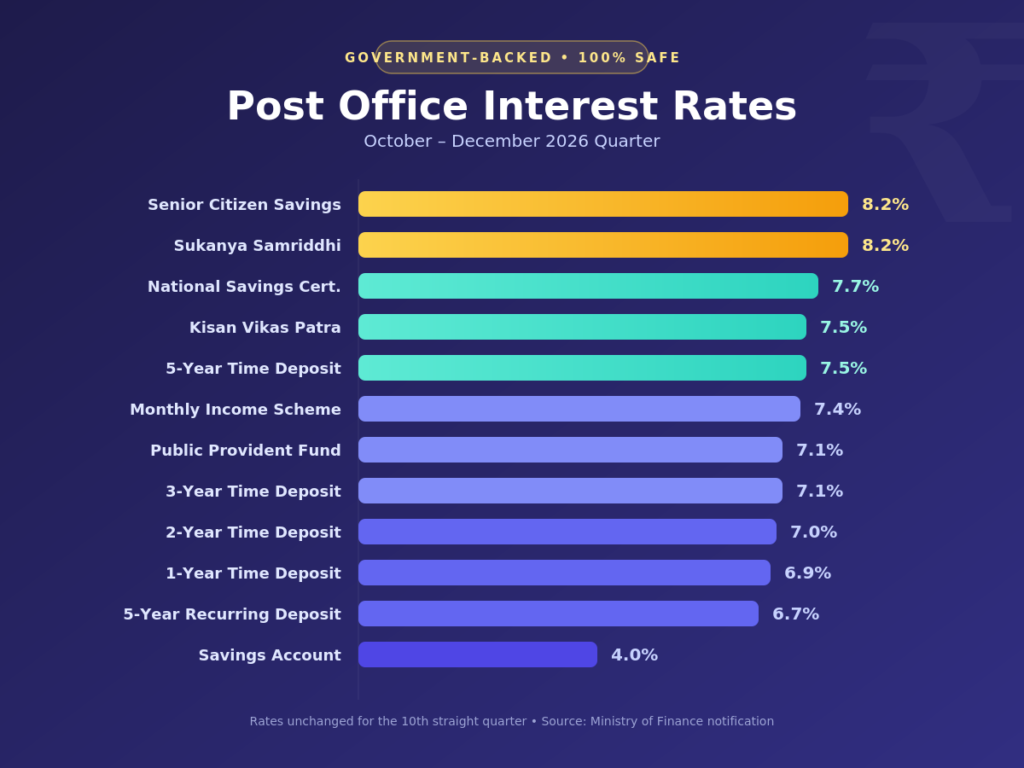
Post Office Interest Rates October–December 2026 at a Glance
The Government of India has kept the interest rates on small savings schemes unchanged for the October to December 2026 quarter. These rates apply from October 1, 2026, to December 31, 2026. The latest revision was notified by the Department of Economic Affairs, Ministry of Finance, on September 30, 2026.
Here is a quick overview of the major Post Office savings schemes and their interest rates for this quarter:
| Post Office Scheme | Interest Rate | Tenure |
|---|---|---|
| Post Office Savings Account | 4.0% per year | No fixed tenure |
| Post Office 1-Year Time Deposit | 6.9% per year | 1 year |
| Post Office 2-Year Time Deposit | 7.0% per year | 2 years |
| Post Office 3-Year Time Deposit | 7.1% per year | 3 years |
| Post Office 5-Year Time Deposit | 7.5% per year | 5 years |
| Post Office Recurring Deposit (RD) | 6.7% per year | 5 years |
| Monthly Income Account (MIS) | 7.4% per year | 5 years |
| National Savings Certificate (NSC) | 7.7% per year | 5 years |
| Kisan Vikas Patra (KVP) | 7.5% per year | 115 months |
| Public Provident Fund (PPF) | 7.1% per year | 15 years |
| Sukanya Samriddhi Account (SSY) | 8.2% per year | 21 years from account opening |
Note: The interest rate shown above is the applicable rate for the October–December 2026 quarter. The Government reviews small savings interest rates periodically, so future quarterly rates can change.
What Does “Rates Unchanged” Mean?
“Unchanged” means that the Government has not increased or reduced the notified interest rates for this quarter. Therefore, the rates applicable during the previous quarter continue for October, November and December 2026.
However, the interest rate is only one part of a savings scheme. Each Post Office scheme has different rules regarding investment limits, tenure, interest calculation, maturity and withdrawal. Therefore, it is important to understand the individual scheme before comparing them.
In the sections below, we will look at each major Post Office scheme in more detail, including its current interest rate, tenure, basic rules and how the interest works.
PPF Interest Rate October–December 2026
The Public Provident Fund (PPF) is one of the most well-known long-term savings schemes in India. It is designed for people who want to build long-term savings with a fixed government-notified interest rate.
For the October–December 2026 quarter, the PPF interest rate remains 7.1% per year. The rate has been kept unchanged for this quarter.
PPF Interest Rate for October–December 2026
| Particular | Details |
|---|---|
| Current interest rate | 7.1% per year |
| Basic tenure | 15 years |
| Minimum yearly deposit | ₹500 |
| Maximum yearly deposit | ₹1.5 lakh |
| Interest calculation | Based on the monthly balance |
| Interest credit | Annually |
The PPF account has a 15-year maturity period, although the account can be extended in blocks of five years subject to the applicable rules.
How Does PPF Interest Work?
PPF interest is not simply calculated on the total amount you have deposited throughout the year. The balance in the account during the relevant period is considered for interest calculation.
For example, suppose you regularly deposit money into your PPF account. The timing of your deposit can affect the interest earned for that year. This is why people who contribute regularly should understand how the monthly balance is considered.
PPF works through long-term compounding, which means the interest credited to the account can itself contribute to future interest earnings.
If you want to estimate how much your PPF investment could grow over the long term, you can use our PPF Calculator to calculate the estimated maturity amount based on your investment and the applicable interest rate.
Why Do People Consider PPF for Long-Term Savings?
PPF has a long 15-year tenure, so it is generally used for long-term financial goals rather than short-term savings.
Some important features include:
- Government-notified interest rate
- Long-term investment period
- Annual deposit limit of ₹1.5 lakh
- Compounding of interest
- Provision for partial withdrawals and loans subject to applicable rules
- Tax benefits are available under the applicable income-tax provisions
However, PPF has specific rules regarding deposits, withdrawals, loans, maturity and tax treatment. Therefore, readers should check the latest official rules before making financial decisions.
PPF Interest Rate Can Change in Future
The 7.1% rate mentioned in this article applies to October–December 2026. Small savings interest rates are reviewed by the Government periodically, so the rate applicable in a future quarter may be different.
Therefore, if you are comparing PPF returns over many years, do not assume that today’s interest rate will necessarily remain unchanged throughout the entire investment period.
Sukanya Samriddhi Yojana Interest Rate October–December 2026
Sukanya Samriddhi Yojana (SSY) is a government-backed savings scheme designed specifically for the financial future of a girl child. Parents or legal guardians can open an SSY account for an eligible girl and make deposits according to the scheme rules.
For the October–December 2026 quarter, the Sukanya Samriddhi Account interest rate is 8.2% per year. The Government has kept this rate unchanged for the quarter. The 8.2% rate has continued since January 2024.
SSY Interest Rate for October–December 2026
| Particular | Details |
|---|---|
| Current interest rate | 8.2% per year |
| Account for | Eligible girl child |
| Maximum age for opening | Below 10 years |
| Deposit period | Up to 15 years from account opening |
| Maturity | 21 years from the date of account opening |
| Minimum yearly deposit | ₹250 |
| Maximum yearly deposit | ₹1.5 lakh |
| Interest | Compounded annually |
The interest rate is announced by the Government and may change in future quarters. Therefore, the 8.2% rate should not be assumed to remain the same for the entire SSY maturity period.
Who Can Open a Sukanya Samriddhi Account?
An SSY account can generally be opened for a girl child who is below 10 years of age at the time of opening the account. The account is operated according to the rules of the Sukanya Samriddhi Account Scheme.
The scheme is intended to help families build long-term savings for goals such as a girl’s higher education or other eligible future needs.
How Much Can You Deposit in SSY?
The minimum annual deposit is ₹250, while the maximum amount that can be deposited in an SSY account in a financial year is ₹1.5 lakh.
For example, if a family deposits ₹2,000 every month, the yearly contribution would be:
₹2,000 × 12 = ₹24,000
Similarly, a monthly deposit of ₹5,000 would amount to ₹60,000 in a year.
The actual maturity amount will depend on the deposits made, the applicable interest rates over the years and the scheme rules.
How Does SSY Interest Work?
SSY is a long-term savings scheme, so the effect of compounding can become significant over a long period.
The interest rate is notified by the Government for the applicable period. Since the rate can be revised in future quarters, calculations made today should be treated as estimates rather than a guaranteed maturity amount based on today’s rate for all future years.
If you want to estimate the potential maturity value based on your yearly investment, you can use our Sukanya Samriddhi Yojana Calculator.
The calculator can make it easier to understand how your contribution and the assumed interest rate may affect the estimated maturity amount.
SSY Maturity Period
The SSY account generally matures 21 years from the date of opening the account, subject to the applicable scheme rules.
An important point is that the deposit period and maturity period are not the same. Contributions are required for up to 15 years from the account opening, while the account generally matures after 21 years from the opening date.
This distinction is useful because many people confuse the 15-year deposit period with the 21-year maturity period.
Is SSY Interest Rate Fixed for 21 Years?
No. The 8.2% rate is the rate applicable for October–December 2026. It does not mean that the same rate is guaranteed for the complete 21-year maturity period.
The Government reviews small savings interest rates periodically. Future SSY rates may therefore be different.
This is an important point to remember when using any SSY maturity calculator. If a calculator assumes 8.2% for the entire period, the resulting amount is an estimate based on that assumption and not a guarantee of the actual future maturity value.
SSY and Tax Benefits
SSY has tax benefits under the applicable income-tax provisions. However, the availability and treatment of deductions can depend on the tax regime and current tax rules.
Therefore, taxpayers should check the latest income-tax rules applicable to them before claiming any tax benefit.
Why Check the Latest SSY Interest Rate?
Because SSY is a long-term account, even a small change in the applicable interest rate can affect the estimated value over many years.
If you are planning a contribution or calculating a possible maturity amount, always use the latest officially announced interest rate and remember that future rates may change.
For October–December 2026, the applicable SSY interest rate is 8.2% per year.
National Savings Certificate (NSC) Interest Rate October–December 2026
The National Savings Certificate (NSC) is a fixed-income savings scheme available through India Post. It is mainly designed for people who want to save for a fixed period while earning interest at a government-notified rate.
For the October–December 2026 quarter, the NSC interest rate is 7.7% per year. The rate has been kept unchanged for this quarter.
NSC Interest Rate for October–December 2026
| Particular | Details |
|---|---|
| Current interest rate | 7.7% per year |
| Maturity period | 5 years |
| Minimum investment | ₹1,000 |
| Maximum investment | No maximum limit |
| Interest | Compounded annually |
| Interest payment | Paid at maturity |
The interest rate mentioned above applies to NSC investments made under the applicable rules during the October–December 2026 quarter. Future interest rates can be different because small savings rates are reviewed periodically.
How Does NSC Work?
NSC works differently from a recurring deposit because you generally invest a lump sum rather than making a mandatory monthly contribution.
For example, suppose you purchase an NSC for ₹10,000. The investment earns interest at the applicable rate, and the interest is compounded annually. The certificate matures after five years under the applicable scheme rules.
The actual maturity value depends on the applicable interest rate and the rules in force for the investment.
One useful feature of NSC is that the interest is compounded annually but paid at maturity. This means you do not normally receive the interest as a monthly or yearly cash payment during the five-year period.
NSC Investment Example
Suppose you invest ₹10,000 in NSC at an annual interest rate of 7.7%.
The interest is compounded over the five-year maturity period. The calculation can be understood as:
Initial investment → Annual interest → Interest added to the investment → Further interest on the accumulated amount
This compounding process allows the investment to grow over the maturity period.
The example is only for understanding how compounding works. The applicable rate and official scheme rules should always be checked before making an investment.
What Is the NSC Maturity Period?
The standard maturity period of NSC is five years.
Unlike some long-term savings schemes, NSC does not have a 15-year or 21-year basic maturity period. This makes its five-year maturity period an important feature for people comparing different fixed-income savings products.
However, premature encashment is subject to specific conditions under the NSC rules. Therefore, investors should not assume that the certificate can always be withdrawn before maturity without restrictions.
Is NSC Interest Taxable?
NSC has specific tax treatment under the applicable income-tax provisions. The investment may also qualify for a deduction under Section 80C, subject to the applicable conditions and limits.
The interest earned on NSC is generally treated according to the prevailing tax rules. Since tax treatment can depend on the taxpayer’s circumstances and the applicable tax regime, it is important to check the latest income-tax rules before claiming any deduction or calculating the tax impact.
NSC vs Other Post Office Schemes
NSC can be compared with schemes such as PPF, Post Office RD, KVP and Time Deposit, but these products have different investment periods, interest-crediting methods, withdrawal rules and tax treatment.
For example:
- NSC: 5-year maturity
- PPF: 15-year basic maturity
- KVP: Maturity period depends on the notified rate
- Post Office RD: Regular monthly deposits for the applicable tenure
- Time Deposit: Fixed deposit for a selected period
Therefore, comparing only the interest rate does not provide a complete picture of how a savings scheme works.
Is the 7.7% NSC Rate Guaranteed for Future Years?
The 7.7% rate is applicable to the October–December 2026 quarter. It should not be treated as a permanent rate for all future NSC investments.
The Government reviews small savings interest rates periodically. Once an NSC is purchased, the applicable interest structure for that certificate is governed by the scheme rules, while the rate announced for a future quarter applies according to the rules governing new investments.
For this reason, always check the latest official notification when planning a new NSC investment.
Key Points About NSC in October 2026
- The current NSC interest rate is 7.7% per year.
- The standard maturity period is five years.
- The minimum investment is ₹1,000.
- Interest is compounded annually and paid at maturity.
- There is no maximum investment limit under the scheme.
- Tax benefits and tax treatment are subject to the applicable income-tax rules.
- The 7.7% rate applies to the October–December 2026 period.
If you are comparing NSC with other Post Office savings schemes, look at the interest rate, tenure, investment requirements, liquidity and tax treatment together rather than focusing on the rate alone.
Kisan Vikas Patra (KVP) Interest Rate October–December 2026
Kisan Vikas Patra (KVP) is a small savings scheme offered through India Post. It is designed for people who want to invest a lump sum amount and allow it to grow over a fixed period.
For the October–December 2026 quarter, the Kisan Vikas Patra interest rate is 7.5% per year. At this rate, a KVP investment matures in 115 months, or 9 years and 7 months. The Government has kept the rate unchanged for this quarter.
KVP Interest Rate for October–December 2026
| Particular | Details |
|---|---|
| Current interest rate | 7.5% per year |
| Maturity period | 115 months (9 years 7 months) |
| Minimum investment | ₹1,000 |
| Maximum investment | No maximum limit |
| Interest | Compounded annually |
| Main feature | Investment doubles at maturity |
The minimum amount required to open a KVP is ₹1,000, and there is no maximum investment limit under the scheme.
How Does KVP Work?
KVP is different from a Post Office RD because you do not need to make a monthly deposit. Instead, you invest a lump sum amount and keep it invested until maturity.
The key feature of KVP is that the investment doubles over the applicable maturity period.
For certificates purchased during the October–December 2026 quarter, the applicable maturity period is 115 months.
For example, if an eligible KVP investment of ₹10,000 is made at the applicable rate, the amount becomes ₹20,000 at maturity, subject to the scheme’s applicable rules.
The doubling period is linked to the interest rate applicable when the certificate is purchased. If the Government changes the rate in a future quarter, that can affect the maturity period for new KVP investments.
KVP Minimum and Maximum Investment
The minimum investment amount for KVP is ₹1,000.
There is no maximum investment limit under the scheme. Investments can generally be made in multiples of ₹100 after the minimum amount, subject to the applicable rules.
This makes KVP different from schemes such as PPF, where there is a maximum annual contribution limit.
Can You Withdraw KVP Before Maturity?
KVP is intended to be held until maturity, but premature closure is permitted in certain situations under the applicable rules.
For example, the India Post scheme information states that premature closure can be allowed after 2 years and 6 months, subject to the applicable conditions.
Therefore, investors should not assume that the full maturity benefit will be available if they close the certificate early.
Is KVP Interest Tax-Free?
KVP does not provide the same tax treatment as some tax-saving investments. The interest earned is generally taxable according to the applicable income-tax rules.
KVP investment does not qualify for a deduction under Section 80C.
Since tax rules can change and the tax impact depends on the individual’s circumstances, readers should check the latest income-tax rules before making an investment decision.
Does the KVP Interest Rate Stay the Same Forever?
The 7.5% rate applies to KVP certificates purchased during the October–December 2026 period.
The Government reviews small savings interest rates periodically. However, the applicable rate and maturity period are determined according to the rules for the certificate when it is purchased.
This means that a future change in the KVP rate does not simply change the maturity value of an already purchased certificate. Future rate changes generally affect new certificates issued under the revised terms.
KVP at a Glance
The main points to remember are:
- Interest rate: 7.5% per year
- Maturity period: 115 months
- Equivalent period: 9 years and 7 months
- Minimum investment: ₹1,000
- Maximum investment: No maximum limit
- Investment type: Lump-sum investment
- Main feature: Investment doubles at maturity
- Premature closure: Allowed only under applicable conditions
If you are comparing KVP with PPF, NSC, RD or other Post Office schemes, consider the interest rate, maturity period, liquidity and tax treatment together. The highest interest rate alone does not tell you how suitable a scheme may be for a particular financial goal.
Post Office Recurring Deposit (RD) Interest Rate October–December 2026
The Post Office Recurring Deposit (RD) is designed for people who want to save a fixed amount regularly instead of investing a large lump sum at one time. It can be useful for building a savings habit because the investor deposits money every month for the prescribed tenure.
For the October–December 2026 quarter, the Post Office RD interest rate is 6.7% per year. The Government has kept the rate unchanged for this quarter.
Post Office RD Interest Rate for October–December 2026
| Particular | Details |
|---|---|
| Current interest rate | 6.7% per year |
| Tenure | 5 years |
| Deposit frequency | Monthly |
| Minimum monthly deposit | ₹100 |
| Maximum deposit | No prescribed maximum limit |
| Interest | Compounded quarterly |
| Account type | Recurring deposit |
The Post Office RD has a basic tenure of five years, so regular monthly deposits continue throughout the five-year period according to the applicable scheme rules.
How Does Post Office RD Work?
A Post Office RD works on the simple idea of making a fixed deposit every month.
For example, if you choose to deposit ₹1,000 per month, you would contribute:
₹1,000 × 12 = ₹12,000 per year
Over five years, your total deposits would be:
₹1,000 × 60 months = ₹60,000
The maturity amount will be higher than the total amount deposited because the account earns interest according to the applicable RD rules.
However, the final maturity amount should not be calculated simply by adding 6.7% to the total deposits. Post Office RD has its own interest calculation method because deposits are made at different times during the five-year period.
Example: ₹1,000 Monthly Post Office RD
Suppose you deposit ₹1,000 every month for five years.
Your total contribution would be:
₹1,000 × 60 = ₹60,000
The account will also earn interest during the investment period. The exact maturity amount depends on the applicable interest calculation and the rules in force.
If you want to calculate the estimated maturity amount for different monthly deposits, you can use our Post Office RD Calculator.
You can try different amounts such as:
- ₹500 per month
- ₹1,000 per month
- ₹2,000 per month
- ₹5,000 per month
This makes it easier to understand how changing your monthly contribution can affect the estimated maturity value.
What Is the Minimum Deposit for Post Office RD?
The minimum monthly deposit for a Post Office RD account is ₹100. Deposits can generally be made in multiples of ₹10, subject to the applicable rules.
There is no fixed maximum monthly deposit limit prescribed for the account, although the investor must follow the applicable Post Office rules.
Because the minimum amount is relatively small, an RD can be used to develop a regular saving habit without requiring a large initial investment.
What Happens If You Miss an RD Deposit?
An RD requires regular monthly deposits. If a required deposit is not made on time, a default fee may apply under the scheme rules.
Therefore, anyone opening a Post Office RD should keep the monthly due date in mind and maintain enough balance to make the required deposit.
The account does not work like a one-time fixed deposit. The regular monthly contribution is an important part of the scheme.
Can You Extend a Post Office RD After Five Years?
The standard Post Office RD tenure is five years. Subject to the applicable rules, an RD account may be extended after maturity.
If you are planning to continue saving beyond the original five-year period, check the latest India Post rules for the extension process, interest applicable during the extended period and other conditions.
Is Post Office RD Interest Tax-Free?
The interest earned on a Post Office RD is not automatically tax-free. The tax treatment depends on the applicable income-tax rules and the individual’s circumstances.
Therefore, do not assume that the entire RD maturity amount is exempt from tax simply because the account is operated through a Post Office.
If you are comparing Post Office RD with bank recurring deposits or other savings products, consider both the expected return and the applicable tax treatment.
Is the 6.7% RD Rate Fixed Forever?
No. The 6.7% interest rate is the rate applicable to the Post Office RD for the October–December 2026 quarter. Small savings interest rates are reviewed by the Government periodically.
Future quarterly rates may change according to the Government’s notifications.
Therefore, when writing about or calculating current Post Office RD returns, always use the latest applicable rate and clearly mention the period to which the rate applies.
Post Office RD: Key Points
- Interest rate: 6.7% per year
- Tenure: 5 years
- Minimum monthly deposit: ₹100
- Deposit frequency: Monthly
- Interest: Compounded according to the applicable RD rules
- Example: ₹1,000 monthly deposit = ₹60,000 total deposits over five years
- Current rate period: October–December 2026
The calculator can be especially useful for long-tail searches such as “Post Office RD Calculator for monthly ₹1,000”, because you can quickly compare different monthly deposit amounts and understand the estimated maturity value.
Post Office Monthly Income Scheme (MIS) Interest Rate October–December 2026
The Post Office Monthly Income Scheme (MIS) is a savings scheme designed for people who want to invest a lump sum and receive interest as a regular monthly income.
For the October–December 2026 quarter, the Post Office MIS interest rate is 7.4% per year. The Government has kept the rate unchanged for this quarter.
Post Office MIS Interest Rate for October–December 2026
| Particular | Details |
|---|---|
| Current interest rate | 7.4% per year |
| Tenure | 5 years |
| Minimum investment | ₹1,000 |
| Maximum investment — Single account | ₹9 lakh |
| Maximum investment — Joint account | ₹15 lakh |
| Interest payment | Monthly |
| Investment type | Lump sum |
The MIS is different from a Post Office RD because you do not make a monthly deposit. Instead, you invest a lump sum and receive interest periodically.
How Does Post Office MIS Work?
The basic idea behind MIS is simple.
You deposit a lump sum amount into the account. The account earns interest at the applicable rate, and the interest is paid to you every month.
For example, at an annual interest rate of 7.4%, an investment of ₹1 lakh would generate approximately:
₹1,00,000 × 7.4% = ₹7,400 per year
Dividing this annual interest into 12 months gives approximately:
₹7,400 ÷ 12 = ₹616.67 per month
This is a simple illustration based on the current rate. The actual account operation is governed by the applicable Post Office rules.
Example: ₹9 Lakh Investment in MIS
The maximum deposit limit for a single MIS account is ₹9 lakh. At the current 7.4% annual interest rate, the annual interest on ₹9 lakh would be:
₹9,00,000 × 7.4% = ₹66,600 per year
The corresponding monthly interest would be:
₹66,600 ÷ 12 = ₹5,550 per month
So, an eligible single account with a ₹9 lakh deposit would receive ₹5,550 per month at the current rate, assuming the full amount remains invested and the applicable rules remain unchanged.
For a joint account with the maximum eligible deposit of ₹15 lakh, the monthly interest at 7.4% would be approximately ₹9,250.
These examples show the income generated from the current interest rate. They should not be treated as a guarantee that the same rate will apply to future deposits.
What Is the Minimum Investment in Post Office MIS?
The minimum amount required to open a Post Office MIS account is ₹1,000. Further deposits are made according to the applicable multiples and account rules.
The maximum deposit limit is:
- ₹9 lakh for a single account
- ₹15 lakh for a joint account
The investment limit applies according to the rules of the scheme, so depositors should check the latest India Post guidelines before opening or adding to an account.
How Long Is the MIS Tenure?
The standard tenure of a Post Office MIS account is five years.
This means the account is intended to remain active for five years from the date of opening, subject to the applicable rules.
After maturity, the account can be closed and the eligible principal amount can be received according to the scheme rules.
Can You Close MIS Before Five Years?
Premature closure is possible subject to specific conditions.
According to the current scheme details, an MIS account can generally be closed after one year from the date of opening, but applicable deductions or conditions may apply.
Therefore, MIS should not be considered the same as a normal savings account where the money can always be withdrawn freely without any conditions.
If you may need the money soon, understand the premature-closure rules before depositing a large amount.
Is MIS Interest Tax-Free?
The interest received from a Post Office MIS is not automatically tax-free.
The interest is generally considered while calculating taxable income according to the applicable income-tax rules. The actual tax impact depends on the individual’s income, tax regime and other circumstances.
Therefore, the monthly income shown by an MIS calculation should not automatically be considered as the amount you will keep after tax.
MIS vs Post Office RD
MIS and RD work in very different ways.
| Feature | Post Office MIS | Post Office RD |
|---|---|---|
| Current rate | 7.4% | 6.7% |
| Investment method | Lump sum | Monthly deposits |
| Tenure | 5 years | 5 years |
| Main purpose | Regular monthly interest | Regular savings |
| Interest payment | Monthly | Compounded according to RD rules |
For example, someone who already has a lump sum and wants regular interest payments may look at MIS, while someone who wants to build savings through monthly contributions may be more interested in RD.
This is a factual comparison of how the schemes work; the suitable option depends on an individual’s financial circumstances and goals.
Is the 7.4% MIS Rate Fixed Forever?
No. The 7.4% rate applies to the October–December 2026 quarter.
The Government reviews small savings interest rates periodically. Future quarterly rates may therefore change.
For an existing account, the applicable rules and rate treatment depend on the scheme terms under which the account was opened. For new deposits, always check the latest official notification before making a decision.
Key Points About Post Office MIS
- Interest rate: 7.4% per year
- Tenure: 5 years
- Minimum investment: ₹1,000
- Maximum single-account deposit: ₹9 lakh
- Maximum joint-account deposit: ₹15 lakh
- Interest payment: Monthly
- Current rate period: October–December 2026
- Example: ₹9 lakh can generate approximately ₹5,550 monthly at 7.4%
The main difference between MIS and many other Post Office savings schemes is that MIS is structured around regular monthly interest income from a lump-sum deposit.
Always check the latest Post Office rules and Government notifications because small-savings rates and scheme conditions can be revised in future.
Post Office Time Deposit Interest Rates October–December 2026
The Post Office Time Deposit (TD) is a fixed-term savings scheme offered through India Post. It works in a similar way to a bank fixed deposit because you invest a lump sum for a selected period and earn interest according to the applicable rate.
For the October–December 2026 quarter, the Government has kept all four Post Office Time Deposit interest rates unchanged. The applicable rates are 6.9% for 1 year, 7.0% for 2 years, 7.1% for 3 years and 7.5% for 5 years.
Post Office Time Deposit Rates for October–December 2026
| Time Deposit Tenure | Interest Rate |
|---|---|
| 1 Year | 6.9% per year |
| 2 Years | 7.0% per year |
| 3 Years | 7.1% per year |
| 5 Years | 7.5% per year |
These rates apply to deposits made during the October 1 to December 31, 2026 quarter. Future quarterly rates may be revised by the Government.
How Does a Post Office Time Deposit Work?
A Time Deposit allows you to invest a lump sum for a fixed period. You can choose a tenure of 1, 2, 3 or 5 years.
For example, suppose you invest ₹1 lakh in a 5-year Post Office Time Deposit at the applicable rate of 7.5%. The deposit earns interest according to the scheme’s rules during the selected tenure.
The interest is calculated quarterly and paid annually, rather than being paid monthly.
The actual amount you receive depends on the deposit amount, tenure, applicable interest rate and the way interest is handled under the Post Office rules.
Minimum Investment in Post Office Time Deposit
A Post Office Time Deposit can generally be opened with a minimum investment of ₹1,000. There is no prescribed maximum deposit limit.
You can choose the tenure according to your savings requirement:
- 1 year — 6.9%
- 2 years — 7.0%
- 3 years — 7.1%
- 5 years — 7.5%
The five-year TD also has specific tax-related provisions under the applicable income-tax rules, so investors should check the latest tax rules before relying on any tax benefit.
Example: ₹1 Lakh Post Office Time Deposit
Suppose you deposit ₹1,00,000 in a Post Office Time Deposit.
At the current rates, the annual interest can be illustrated as follows:
| Tenure | Rate | Approx. Interest on ₹1 Lakh for One Year* |
|---|---|---|
| 1 Year | 6.9% | ₹6,900 |
| 2 Years | 7.0% | ₹7,000 |
| 3 Years | 7.1% | ₹7,100 |
| 5 Years | 7.5% | ₹7,500 |
*This is a simple illustration of annual interest at the stated rate. It is not the final maturity calculation, because Post Office TD interest is calculated and paid according to the scheme’s specific rules.
Can You Choose Different Time Deposit Tenures?
Yes. One useful feature of the Post Office TD is that it offers multiple fixed tenures.
Someone looking for a shorter fixed period can consider the 1-year or 2-year TD, while the 3-year and 5-year options provide longer investment periods.
The interest rate also differs by tenure, so comparing the rates and the period together is important.
Can a Post Office Time Deposit Be Extended?
A Time Deposit can be extended according to the applicable Post Office rules. The rules regarding extension, interest and the applicable rate should be checked at the time of maturity.
Do not assume that an extension will automatically receive the same rate as the original deposit. The applicable rules and rates at the time of extension matter.
Is Post Office Time Deposit Interest Taxable?
Interest earned from a Post Office Time Deposit is subject to the applicable income-tax rules.
The tax treatment can depend on the type of deposit, the investor’s income and the applicable tax regime. Therefore, the interest shown in a calculator should not automatically be considered as post-tax income.
If you are using a Post Office TD for tax planning, check the latest income-tax provisions before making a decision.
Are Post Office Time Deposit Rates Fixed Forever?
No. The rates mentioned in this article are specifically for the October–December 2026 quarter.
The Government reviews small savings interest rates periodically. Therefore, rates announced for future quarters can be different.
For a new deposit, always check the latest official notification before investing.
Post Office Time Deposit: Key Points
- 1-year TD: 6.9%
- 2-year TD: 7.0%
- 3-year TD: 7.1%
- 5-year TD: 7.5%
- Minimum investment: ₹1,000
- Maximum investment: No prescribed upper limit
- Interest calculation: Quarterly
- Interest payment: Annually
- Current rate period: October–December 2026
Post Office Time Deposit is therefore different from Post Office RD, where you make regular monthly deposits. In a Time Deposit, you generally invest a lump sum for a selected fixed period.
When comparing a Post Office TD with a bank FD or another savings scheme, look at the interest rate, tenure, liquidity, tax treatment and applicable rules rather than comparing the interest rate alone.
Why Did Post Office Interest Rates Remain Unchanged for October–December 2026?
The Government of India reviews the interest rates on small savings schemes every quarter. For the October–December 2026 quarter, the government decided to keep the existing interest rates unchanged.
The Department of Economic Affairs issued the notification for the third quarter of FY 2026–27 on September 30, 2026. The rates applicable from October 1 to December 31, 2026 remain the same as those applicable during the previous quarter.
This means there is no change in the rates of popular schemes such as PPF, Sukanya Samriddhi Yojana, NSC, Kisan Vikas Patra, Post Office RD, MIS and Time Deposits for this quarter.
How Often Are Post Office Interest Rates Reviewed?
Post Office small savings interest rates are reviewed every three months. The government can change the rates for a new quarter or decide to continue with the existing rates.
For October–December 2026, the existing rates have been retained. Therefore, people opening or investing in eligible schemes during this quarter will see the applicable rates listed in this article.
It is important to remember that an interest rate announced for one quarter does not mean the same rate will continue for the entire tenure of a scheme. Future quarterly reviews can result in changes, depending on government decisions and the applicable small-savings framework.
What Factors Influence Small Savings Interest Rates?
Small savings rates are linked to government securities and market interest-rate conditions. The government considers factors such as yields on government securities of comparable maturities while determining small savings rates.
However, the rate applicable to a particular quarter is ultimately notified by the government. Therefore, the market movement of government securities does not automatically mean that Post Office scheme rates will change in the same proportion.
Does an Unchanged Rate Mean the Scheme Is Guaranteed to Keep the Same Rate?
No.
For example, if PPF is available at 7.1% for October–December 2026, this does not mean that PPF will necessarily remain at 7.1% throughout the entire 15-year tenure.
Similarly, the 8.2% Sukanya Samriddhi rate shown for October–December 2026 should not be treated as a fixed rate for the entire maturity period.
The government reviews small savings rates periodically, so investors should check the latest official notification before making decisions based on current rates.
What Does the October–December 2026 Decision Mean for Existing Investors?
For existing investors, the unchanged rates mean there is no rate revision for these schemes for the October–December 2026 quarter.
For people comparing different Post Office schemes, the current rates provide a useful starting point, but interest rate alone should not be the only factor considered. Tenure, deposit limits, withdrawal rules, taxation, liquidity and the purpose of saving can also differ significantly between schemes.
For this reason, it is useful to understand each scheme separately rather than comparing only the percentage rate.
Which Post Office Schemes Have the Highest Interest Rates in October–December 2026?
The interest rates offered by Post Office small savings schemes are different because each scheme has different rules, eligibility conditions, tenure and withdrawal provisions.
For the October–December 2026 quarter, Sukanya Samriddhi Yojana (SSY) and Senior Citizens Savings Scheme (SCSS) carry the highest listed interest rate at 8.2% per year. However, these schemes are designed for specific categories of savers and have their own eligibility requirements.
Other major schemes offer rates between 6.7% and 7.7%. The rates notified for the quarter are shown below.
Post Office Interest Rate Comparison
| Post Office Scheme | Interest Rate | Main Tenure / Payment Pattern |
|---|---|---|
| Sukanya Samriddhi Yojana (SSY) | 8.2% | Long-term savings for eligible girl child |
| Senior Citizens Savings Scheme (SCSS) | 8.2% | 5 years |
| National Savings Certificate (NSC) | 7.7% | 5 years |
| Kisan Vikas Patra (KVP) | 7.5% | Matures in 115 months |
| 5-Year Time Deposit | 7.5% | 5 years |
| Monthly Income Account (MIS) | 7.4% | 5 years; interest paid monthly |
| 3-Year Time Deposit | 7.1% | 3 years |
| PPF | 7.1% | 15-year maturity period |
| 2-Year Time Deposit | 7.0% | 2 years |
| 1-Year Time Deposit | 6.9% | 1 year |
| 5-Year Recurring Deposit | 6.7% | 5 years; monthly deposits |
The rates above apply to the October 1–December 31, 2026 quarter.
Why Should You Not Compare Schemes Only by Interest Rate?
A higher interest rate does not automatically mean that two schemes work in the same way.
For example, SSY is specifically designed for eligible girl children and has long-term rules. PPF has a 15-year maturity structure and allows deposits within specified annual limits. NSC has a five-year maturity period, while Post Office RD requires regular monthly deposits for its five-year term.
Similarly, MIS is structured around monthly interest payments, while some other schemes accumulate interest until maturity.
Therefore, when comparing Post Office schemes, it is useful to look at:
- Interest rate
- Investment or deposit limit
- Tenure
- Eligibility
- Frequency of interest payment
- Compounding method
- Premature withdrawal rules
- Tax treatment
- Liquidity requirements
- Purpose of the investment
This makes the comparison more meaningful than simply looking at the highest percentage.
A Simple Example
Suppose two schemes show different annual interest rates. One may offer a higher rate but require a longer holding period or have more specific eligibility rules. Another may have a lower rate but provide a different payment structure or shorter tenure.
This is why the interest rate should be viewed together with the complete scheme rules.
The rates can also change when the government announces a new quarterly notification. The Department of Economic Affairs publishes the official small savings rate notifications for each quarter.
For readers who want to estimate returns for a particular scheme, a calculator can also make the comparison easier. For example, you can use our PPF Calculator to estimate PPF maturity and our Post Office RD Calculator to understand how regular monthly deposits can grow over time.
How Are Post Office Interest Rates Decided?
Post Office small savings interest rates are not decided separately by individual post offices. The rates are notified by the Government of India through the Department of Economic Affairs (DEA), Ministry of Finance.
The government reviews small savings interest rates every quarter and issues an official notification stating the rates applicable for that period. The DEA’s official records show a separate notification for the Q3 FY 2026–27, covering the October–December 2026 quarter.
Link Between Small Savings Rates and Government Securities
The interest-rate framework for small savings has been linked with the yields on comparable Central Government Securities (G-Secs).
The Shyamala Gopinath Committee recommended that small savings rates should broadly be aligned with government security rates of similar maturity, with an additional spread depending on the particular scheme. The Department of Economic Affairs has also stated that small savings rates are decided in view of these recommendations.
For example, a scheme with a particular maturity may be compared with government securities having a similar maturity. This provides a reference point for determining the interest rate.
Does the Formula Automatically Change the Interest Rate?
No.
The framework provides a reference for determining small savings rates, but the government ultimately notifies the rate applicable for each quarter.
This is why changes in government bond yields do not necessarily result in an immediate or proportionate change in every Post Office scheme. The government can decide to retain the existing rates for a particular quarter.
For October–December 2026, the government has retained the existing small savings rates.
Why Are Rates Reviewed Every Three Months?
Quarterly reviews allow the government to reassess small savings rates periodically rather than fixing them permanently for many years.
At the end of each review period, the government can:
- Continue the existing interest rates
- Change the rate of one or more schemes
- Announce revised rates for the next quarter
The decision applies according to the official notification for that particular quarter.
What Should You Check Before Investing?
Because small savings rates can be revised for future quarters, it is important to check the latest government notification rather than relying on an old interest-rate table.
You should also check the specific rules of the scheme, including:
- Current interest rate
- Investment or deposit limits
- Maturity period
- Eligibility requirements
- Interest calculation method
- Payment frequency
- Premature withdrawal rules
- Tax treatment
The rate shown in this article is specifically for October–December 2026 and should not automatically be assumed to apply to future quarters.
For the latest official notifications, readers can check the Department of Economic Affairs’ Small Savings section.
Frequently Asked Questions About Post Office Interest Rates October–December 2026
What are the Post Office interest rates for October–December 2026?
For October–December 2026, the major Post Office small savings rates include 8.2% for Sukanya Samriddhi Yojana and SCSS, 7.7% for NSC, 7.5% for KVP and 5-year Time Deposit, 7.4% for MIS, 7.1% for PPF and 3-year Time Deposit, 7.0% for 2-year Time Deposit, 6.9% for 1-year Time Deposit, and 6.7% for RD. The government has kept the rates unchanged for this quarter.
Which Post Office scheme has an 8.2% interest rate?
For the October–December 2026 quarter, Sukanya Samriddhi Yojana (SSY) and Senior Citizens Savings Scheme (SCSS) carry an interest rate of 8.2% per year. Eligibility and rules are different for both schemes.
What is the PPF interest rate from October to December 2026?
The PPF interest rate is 7.1% per year for the October–December 2026 quarter. PPF is a long-term savings scheme with a standard maturity period of 15 years.
What is the Sukanya Samriddhi interest rate in October 2026?
The Sukanya Samriddhi Yojana interest rate is 8.2% per year for October–December 2026. The rate applies to the quarter notified by the government and should not be assumed to remain unchanged for the entire maturity period.
What is the Post Office RD interest rate for October–December 2026?
The Post Office Recurring Deposit (RD) interest rate is 6.7% per year for October–December 2026. The standard RD tenure is five years, and deposits are made monthly.
What is the NSC interest rate for October–December 2026?
The National Savings Certificate (NSC) interest rate is 7.7% per year for October–December 2026. NSC has a five-year maturity period.
What is the KVP interest rate in October–December 2026?
The Kisan Vikas Patra (KVP) interest rate is 7.5% per year for the October–December 2026 quarter. At the applicable rate, KVP reaches maturity in 115 months, or 9 years and 7 months.
What is the Post Office MIS interest rate in October–December 2026?
The Post Office Monthly Income Scheme (MIS) interest rate is 7.4% per year for October–December 2026. Interest is paid monthly, subject to the scheme’s rules and conditions.
What are the Post Office Time Deposit rates in October–December 2026?
The Time Deposit rates for the October–December 2026 quarter are:
1 year: 6.9%
2 years: 7.0%
3 years: 7.1%
5 years: 7.5%
The applicable rate depends on the selected deposit period.
Can Post Office interest rates change in the future?
Yes. Small savings interest rates are reviewed periodically by the Government of India. The rate applicable during one quarter should not automatically be treated as the rate for future quarters.
The Department of Economic Affairs has published the official notification for the Q3 FY 2026–27 small savings rates dated September 30, 2026.
Are Post Office interest rates guaranteed for the entire tenure?
It depends on the scheme and how its interest rate is administered. A quarterly rate announcement should not be interpreted as a promise that the same rate will apply to every future investment period.
For schemes where the government announces rates applicable to new deposits or accounts for a particular period, always check the rules applicable on the date of investment.
Is the Post Office interest rate the same for every scheme?
No. Different Post Office schemes have different interest rates, tenures, deposit limits and payment structures.
For example, RD is currently 6.7%, PPF is 7.1%, MIS is 7.4%, NSC is 7.7%, and SSY is 8.2% for October–December 2026.
Where can I check the latest Post Office interest rates?
The latest small savings interest-rate notifications are published by the Department of Economic Affairs, Ministry of Finance, Government of India. It is advisable to check the latest government notification when a new quarter begins because rates may be revised.